 English
 Español
 Русский
When people first hear about DTH drilling, it can sound more complicated than it really is. But the idea is actually pretty simple: instead of trying to break hard rock from the surface, you move the hammer down to the bottom of the hole and apply impact directly where the rock resistance is.
In a DTH system, compressed air is sent down through the drill pipe to drive a hammer located just above the drill bit. The hammer continuously delivers impact energy to the bit, while the bit rotates slowly to assist cutting and stability. At the same time, air flow removes cuttings from the hole.
So the whole process is really about one thing: keeping the breaking energy as close as possible to the rock itself, instead of losing it during transmission from the surface.
The main difference is actually very simple: the impact force is generated directly at the bottom of the hole rather than at the surface.
This means the energy doesn’t have to travel through a long drill string before it reaches the rock, so there is much less energy loss. As a result, performance is more stable in deeper holes and in harder formations, where surface-impact systems usually start to lose efficiency.
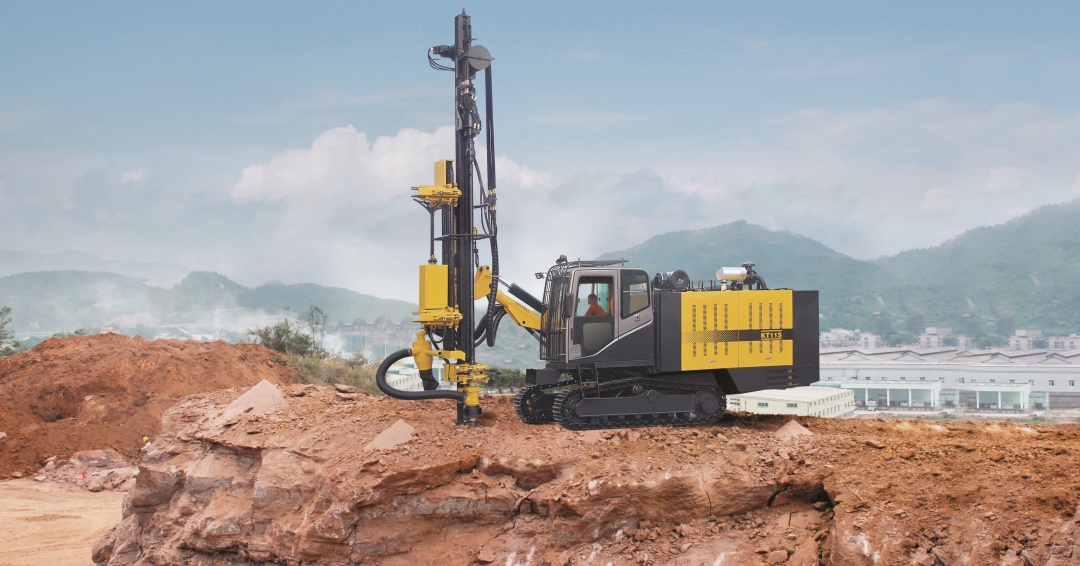
DTH drilling rigs are usually classified by their mobility and working configuration, depending on different site conditions and project requirements.
1. Truck-mounted DTH drilling rig
This type is installed on a truck chassis, allowing fast relocation between different drilling points. It is mainly used for projects that require high mobility and frequent site changes. It performs well on roads with good access conditions and is suitable for multi-well drilling projects.
2. Crawler-mounted DTH drilling rig
This type is built on a crawler chassis, which provides better stability and mobility in rough terrain. It is widely used in mountainous areas, uneven ground, and complex construction environments where truck access is limited.
3. Integrated multifunction DTH drilling rig
This is a more advanced configuration that combines DTH drilling with other methods such as rotary drilling. Operators can switch between different drilling modes depending on formation conditions. It is suitable for complex geology where a single drilling method is not enough.
In real field work, selecting a DTH system is not just about choosing a pressure level or hammer size. It is about matching the system with actual drilling conditions.
Rock hardness, drilling depth, air supply capacity, borehole diameter, and site constraints all affect performance. When these factors are balanced correctly, drilling runs smoothly and efficiently. When they are not, even high-spec equipment can perform poorly.
So in practice, it is always about system matching, not just equipment specification.
This is why it has become one of the most effective methods for hard rock drilling, especially when system configuration is properly matched to field conditions.
This is also why equipment from Kaishan DTH systems are widely used in real projects.
Kaishan DTH systems are designed for stable performance under changing field conditions, with a focus on durability and adaptability. In practice, this helps maintain consistent drilling performance even when formations vary during operation.
At the same time, Kaishan provides configuration support based on real project conditions, helping users select suitable DTH setups instead of relying only on standard catalog specifications.
In drilling work, that kind of matching is often what determines whether the system runs smoothly in the field or struggles once conditions become unpredictable.
