 English
 Español
 Русский
In most water well projects, the hard part is not drilling itself—it’s the decisions made before the drilling starts.
Because once the rig arrives on site, everything changes. You’re no longer adjusting ideas on paper. You’re reacting to real ground conditions, real equipment behavior, and real time pressure. And at that point, even small changes can start to cost time and efficiency.
That’s why the early stage matters so much. Not because it’s complicated, but because it quietly defines how smooth everything will be later.
So before anything goes underground, there are a few practical things worth getting aligned.
Let’s start from the most basic reality: you are drilling into something you cannot see.
You don’t need perfect geological data, but you do need a working understanding of what’s likely there.
Is the formation mostly loose soil? Is there a mix of sand and gravel? Or are you dealing with solid rock layers?
And just as important—what do nearby wells look like? Depth consistency, yield stability, seasonal changes.
Because drilling is always a response to the ground. Never the other way around.
If this part is underestimated, everything else becomes adjustment work instead of planned execution.
Water demand is often discussed too loosely at the beginning.
In reality, you want to think in terms of actual usage behavior:
Peak consumption, not average consumption.
Real pressure needs, not ideal scenarios.
And whether demand will change over time.
Because a well is not something you “fine-tune” easily after construction.
If the system is undersized, performance instability shows up quickly. If it’s oversized, you carry unnecessary cost and complexity throughout operation.
What you want is simple: stable output under real working conditions, not theoretical maximum performance.
Different ground conditions require different drilling behaviors.
In practice, drilling methods are chosen based on how the formation reacts during penetration.
Some formations respond better to clean mechanical cutting with circulation support. Others require high-impact energy directly at the bottom of the hole. And some need constant stabilization to prevent collapse while drilling progresses.
In more complex geology, the method is not fixed from the beginning—it evolves as the formation reveals itself.
A good drilling setup is one that can adapt without forcing the project into a single rigid approach.
Before choosing equipment, it helps to understand what a water well drilling rig actually is.
At its core, a water well drilling rig is a complete mechanical system designed to create a borehole deep enough to reach groundwater. But it’s more than just “drilling.” It integrates several functions at once—rotation, thrust, lifting, and sometimes air or fluid circulation depending on the drilling approach.
In simple terms, it’s the machine that turns an underground concept into a usable water source.
Most rigs in the field are designed with different capabilities rather than completely different identities. Instead of thinking in fixed “types,” it’s more practical to think in functional configurations:
Some rigs are built for efficiency in shallow and moderate-depth formations, where speed and continuous circulation are more important than extreme penetration force.
Some are engineered for high-energy impact work, where the key challenge is breaking through very hard formations rather than maintaining rapid drilling speed.
Some systems are optimized for maintaining borehole stability in difficult or changing ground conditions, where collapse risk is part of the drilling environment.
And many modern rigs are designed as integrated platforms, allowing operators to adjust drilling parameters, air supply, and circulation systems depending on what the formation actually requires on site.
So instead of asking “which rig type is best,” the more accurate question is:
What kind of ground behavior do you expect, and how flexible does your equipment need to be when that expectation changes?
Because in real projects, conditions rarely stay exactly as predicted.
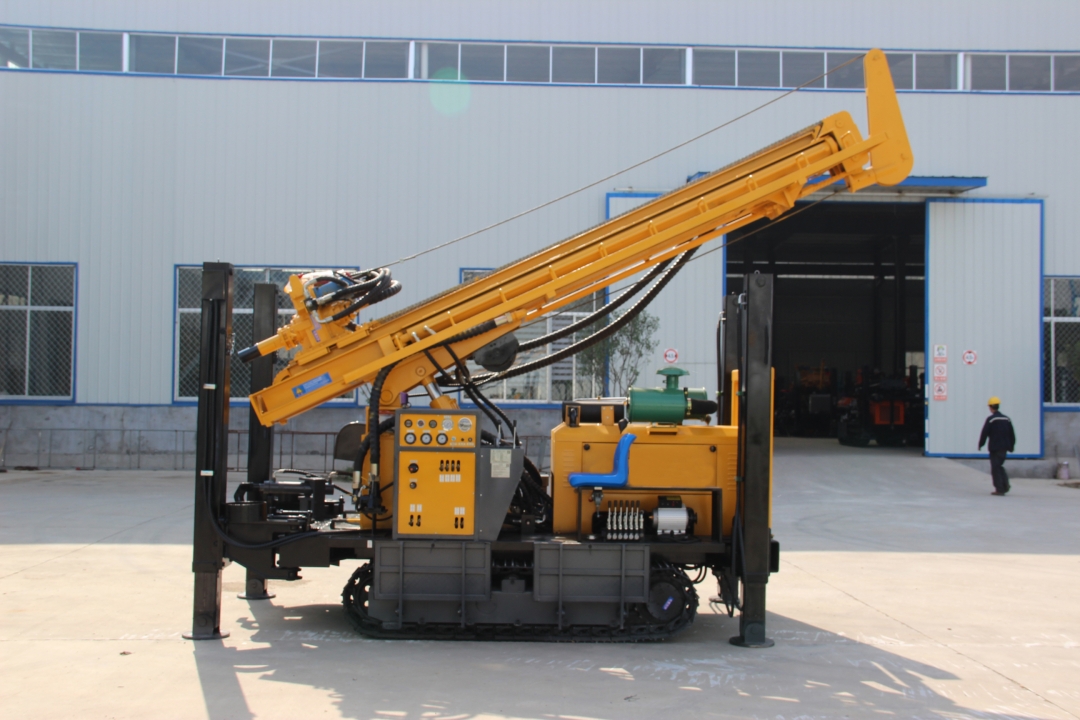
This is where equipment selection becomes very practical.
A drilling rig is not just about depth capability or horsepower. It determines how smoothly the entire drilling process behaves when conditions change.
A well-matched rig should feel stable under variation. It should not struggle every time the formation changes character. It should maintain control without forcing constant correction from the operator.
Equally important is how the system behaves on real sites—not just in specifications. Setup time, mobility between locations, and adaptability to space constraints all affect actual productivity.
And then there’s reliability. Because in drilling, downtime is never neutral. It usually affects borehole stability, schedule continuity, and overall project cost in ways that are not immediately visible.
So in practice, rig selection is less about “choosing a machine” and more about reducing uncertainty in execution.
In real field applications, equipment durability and consistency matter more than theoretical specifications. That’s one of the reasons why Kaishan Group water well drilling rigs are widely used across different drilling environments.
Zhengzhou Kaishan rigs are built with a focus on long-term operational stability. In water well drilling, that translates into fewer unexpected interruptions and more predictable performance under changing ground conditions.
Their systems are designed to support multiple drilling configurations within one platform, which allows operators to adjust working parameters according to actual geological response rather than switching to entirely different equipment.
More importantly, Zhengzhou Kaishan also supports project-based equipment matching. This means the selection process is not limited to catalog specifications. Instead, it can be aligned with real site conditions such as formation type, expected depth, and mobility requirements.
In practical terms, this support usually includes:
1.Evaluating geological and drilling conditions before equipment selection
2.Recommending rig configurations based on real project requirements
3.Assisting with setup planning for different site environments
4.Providing operational guidance to improve drilling efficiency in the field
For procurement teams, this approach reduces a major problem in drilling projects: uncertainty before deployment.
Instead of guessing which machine might fit, the selection is based on how the rig will actually behave once it starts working.
And in water well drilling, that alignment is often what determines whether the project runs smoothly—or becomes unpredictable.
