 English
 Español
 Русский

The service life of a DTH drill bit depends on rock conditions, bit selection, drilling parameters, and maintenance. A suitable bit can maintain drilling performance for longer, while incorrect air supply, excessive feed pressure, or poor flushing can accelerate wear. For drilling contractors and equipment buyers, extending bit life is not just about reducing replacement costs. It also helps maintain stable drilling efficiency and avoid unnecessary downtime.
Different rock formations place different demands on a DTH drill bit. Hard and abrasive rock can cause faster wear on carbide buttons, while fractured formations may increase the risk of uneven wear or button damage.
Button shape and arrangement also matter. Spherical buttons are generally more resistant to impact and are commonly selected for harder rock. Parabolic or ballistic buttons can offer different penetration characteristics, depending on the formation and drilling conditions.
Before selecting a bit, consider rock hardness, abrasiveness, fracture conditions, and the required hole diameter. A bit designed for one formation may not provide the best service life in another.
Compressed air has two important functions in DTH drilling: powering the hammer and removing cuttings from the hole.
If the air pressure is insufficient, the hammer may not operate at its intended performance level. If the air volume is inadequate, rock cuttings may not be removed effectively. Cuttings left around the bit can cause repeated contact with abrasive material, increasing wear and potentially slowing drilling.
The compressor should therefore match the requirements of the DTH hammer, hole diameter, and drilling depth. Buyers should check both working pressure and air delivery volume rather than choosing a compressor based on pressure alone.
More feed pressure does not always mean faster drilling. Excessive pressure can place unnecessary stress on the bit and drilling components, especially when the bit is not making effective contact with the rock.
Rotation speed also needs to match the hammer, bit design, and formation. If the rotation speed is too high or too low, the buttons may not distribute impact evenly across the rock surface. This can lead to uneven wear and reduced drilling performance.
Operators should follow the equipment manufacturer’s recommended operating parameters and adjust feed pressure and rotation speed according to actual drilling conditions.
A DTH drill bit and hammer work together, so wear or damage in one component can affect the performance of the entire drilling system.
Before and after drilling, check the bit for missing, cracked, or excessively worn buttons. Pay attention to the gauge buttons around the outside of the bit, as their wear can affect hole diameter and drilling stability.
The hammer should also be inspected according to the manufacturer’s maintenance recommendations. Worn internal components, damaged threads, or poor connections can affect impact performance and increase the risk of equipment failure.
Replacing a damaged bit at the right time is often more economical than continuing to drill with a bit that has already lost its effective cutting performance.
Drill bit life is affected by the entire drilling system, not just the bit itself. The DTH hammer, drill rods, compressor, and rig must all be compatible.
For example, a larger hole diameter may require a different hammer and higher air volume. A deeper hole also creates greater demands on cuttings removal. If the compressor cannot provide sufficient air delivery under actual operating conditions, drilling performance may decline.
For this reason, equipment buyers should consider the complete configuration when selecting a DTH drilling rig. A suitable combination of rig, hammer, bit, and compressor helps maintain more consistent drilling conditions.
Kaishan offers different DTH drilling rig configurations for open-pit and rock drilling applications.
The KG430S and KG430SH crawler DTH drilling rigs support drilling diameters of 90–152 mm and have an economical drilling depth of 25 m. Both models use the K40 DTH hammer and have an air consumption range of 13–20 m³/min.
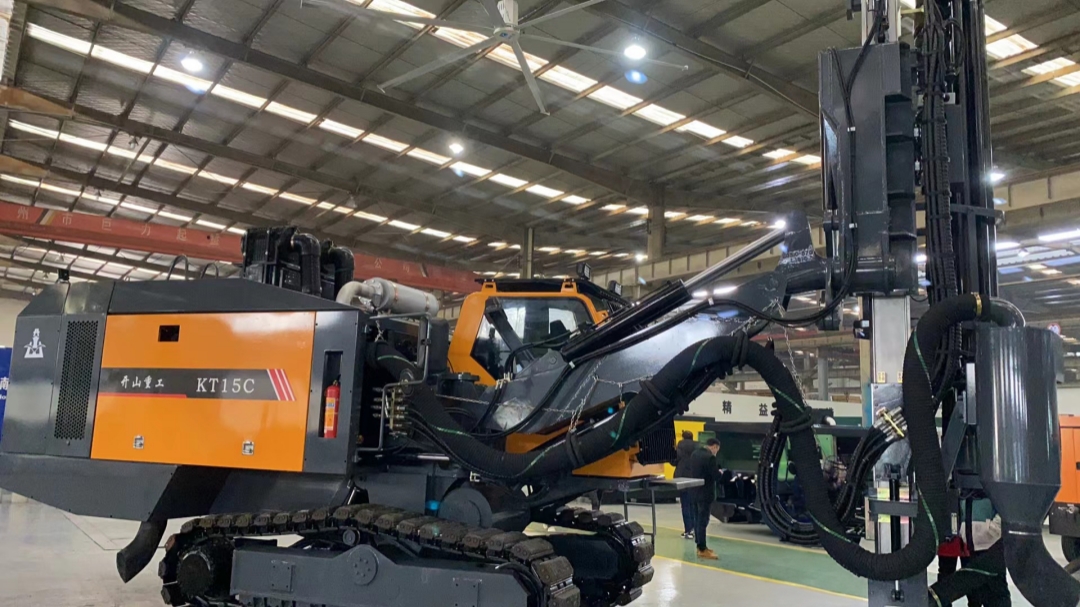
For larger drilling requirements, the KT15C integrated DTH drilling rig supports hole diameters of 140–190 mm and has an economical drilling depth of 36 m. Its built-in compressor delivers 22 m³/min of air at 24 bar.
When selecting a rig, buyers should also confirm the compatible hammer and drill bit specifications. Matching the equipment to the required hole diameter, rock conditions, and drilling depth is essential for maintaining stable performance and getting good service life from drilling tools.
There is no fixed service life for every DTH drill bit. Its lifespan depends on rock hardness, abrasiveness, bit design, drilling parameters, and flushing conditions. A bit drilling in highly abrasive rock may wear much faster than one operating in softer formations.
Common causes include unsuitable bit selection, insufficient air volume, poor cuttings removal, excessive feed pressure, incorrect rotation speed, and abrasive rock conditions. Regular inspection can help identify these problems before they cause serious damage.
A slightly worn bit may still be usable, depending on its condition and the manufacturer’s limits. However, missing or cracked buttons, severe gauge wear, and reduced drilling performance are signs that the bit should be inspected or replaced.
Not necessarily. The air pressure and volume should meet the hammer’s operating requirements. Increasing pressure beyond the recommended range does not automatically extend bit life and may place unnecessary stress on the drilling system.
Choose a bit suitable for the rock formation, maintain proper air supply, use recommended drilling parameters, and inspect the bit regularly. Looking after the hammer and the rest of the drilling system is equally important.
