 English
 Español
 Русский

A hydraulic tunneling drilling rig is an underground drilling machine designed to drill blast holes, rock bolting holes, and other holes during tunnel excavation. Unlike surface drilling rigs, it is built for confined underground spaces, with a compact articulated chassis, flexible boom, and hydraulic drilling system for accurate positioning. Hydraulic tunneling drilling rigs are commonly used in mining, railway, road, and hydropower tunnel construction. The Kaishan KJ321-CYTJ45/2 is a two-boom hydraulic tunneling drilling rig designed for tunnel sections in the 12–45 m² range.
A hydraulic tunneling drilling rig uses hydraulic power to control drilling, feeding, rotation, and boom positioning. The operator can position the drilling booms at different points across the tunnel face and drill holes in vertical, horizontal, or inclined directions.
During tunnel excavation, the rig can drill a pattern of blast holes in the rock face. After blasting, similar equipment or dedicated rock bolting equipment can be used for ground support. The ability to position the boom across a large working area is therefore important for both drilling coverage and tunnel productivity.
The KJ321-CYTJ45/2 uses two flexible booms with 360° beam rotation and self-leveling beams. Its design also allows the booms to be used for lateral cross-cut drilling and rock bolting.
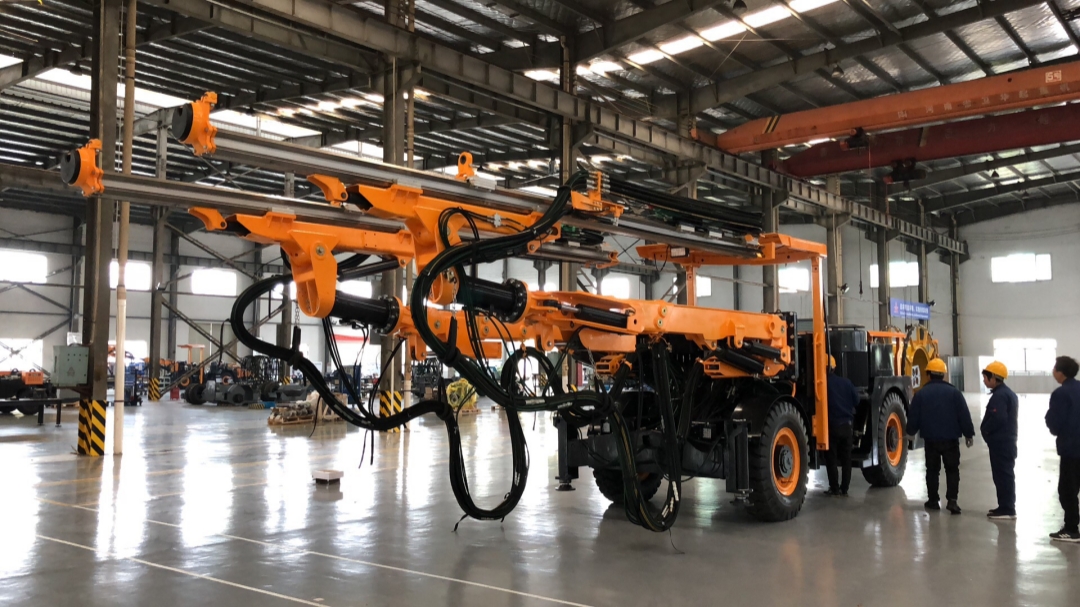
The main applications are underground mining and tunnel excavation, particularly where drilling must be carried out inside a confined tunnel rather than from the surface.
For example, a hydraulic tunneling drilling rig can be used for:
Tunnel face drilling for blasting
Underground mine development
Railway and highway tunnel excavation
Hydropower tunnel construction
Rock bolting and ground-support drilling
Vertical, horizontal, and inclined drilling in underground sections
The required machine depends heavily on the tunnel cross-section. A large jumbo designed for a wide tunnel may not be practical in a narrow mine heading, while a compact machine may not provide enough coverage for a large tunnel face.
The main advantage is that the machine is designed around the constraints of underground drilling.
A conventional surface drilling rig is not necessarily suitable for a narrow tunnel because of its dimensions, boom arrangement, and mobility. A tunneling drilling rig instead combines a compact chassis with flexible drilling booms, allowing the machine to move through confined passages and position the drill at different locations on the tunnel face.
The articulated four-wheel-drive chassis of the KJ321-CYTJ45/2 is designed for movement in narrow tunnels, while its flexible boom arrangement provides broad drilling coverage. The machine also uses a lifting safety roof meeting FOPS and ROPS requirements.
The Kaishan KJ321-CYTJ45/2 Hydraulic Tunneling Drilling Rig is designed for tunnel sections in the 12–45 m² range. It can drill blast holes and rock bolting holes in vertical, inclined, and horizontal directions.
|
Tunnel |
Tunnel section |
12–45 m² |
|
Operating range |
3×4–7.3×6.5 m²; 4×4–8.7×7.8 m²; 4×4–11.5×9.2 m² |
|
|
Machine |
Length |
12,000 mm |
|
Width |
2,160 mm |
|
|
Height |
2,500 / 3,300 mm |
|
|
Weight |
Approx. 22,000 kg |
|
|
Mobility |
Tramming speed |
10 km/h |
|
Maximum climbing capacity |
25% (14°) |
|
|
Engine |
Diesel engine |
Cummins QSB3.9-C125, 93 kW / 2200 rpm |
|
Motor |
2×45 kW or 2×75 kW |
|
|
Rock Drill |
Rock drill |
2×HC50 or 2×HC95LMW/RD 22U |
|
Hole diameter |
Φ32–76 mm or Φ42–102 mm |
|
|
Impact frequency |
62 Hz or 62 / 53 Hz |
|
|
Beam |
Beam rotation |
360° |
|
Feed extension |
1,600 mm |
|
|
Boom extension |
1,200 mm |
|
|
Air & Water System |
Air compressor capacity |
1.55 m³/min |
|
Air pressure |
8 bar |
|
|
Water pump capacity |
10 m³/h |
|
|
Hydraulic & Electrical |
Hydraulic oil tank |
400 L |
|
Working voltage |
380 V |
|
|
Frequency |
50 Hz |
The KJ321-CYTJ45/2 has a relatively large operating envelope for an underground drilling machine, while its 22-ton-class weight and articulated four-wheel-drive chassis are configured for underground mobility. The available rock-drill configurations also allow different hole diameter and drilling performance requirements to be matched to the project.
The first thing to check is tunnel cross-section. The drilling rig must be able to enter the tunnel and provide sufficient boom coverage across the working face.
Next, consider the drilling diameter and drilling method. Blast-hole drilling and rock-bolting applications can require different drilling tools and hole sizes, so the rock drill and feed system should match the planned work.
The machine’s mobility and climbing capability are also important underground. Tunnel floors can be uneven or inclined, and the rig may need to move frequently between drilling positions.
Finally, consider the complete drilling configuration rather than looking at engine power alone. Rock drill type, hydraulic system, boom geometry, feed extension, air and water systems, and operator protection all affect how effectively the rig can work underground.
Kaishan provides a range of underground drilling equipment covering tunneling, mining, rock bolting, and other underground drilling applications. Its tunneling drilling rig range includes different configurations for different tunnel sections and operating requirements.
For a project using the KJ321-CYTJ45/2, the key information for machine selection includes the tunnel cross-section, required hole diameter, drilling direction, rock conditions, and whether the rig will be used for blast-hole drilling, rock bolting, or both.
A hydraulic tunneling drilling rig is mainly used for drilling blast holes and rock-bolting holes during underground tunnel excavation and mining development.
The KJ321-CYTJ45/2 is designed for tunnel sections in the 12–45 m² range, with several operating-range configurations listed by Kaishan.
Depending on the selected rock-drill configuration, the KJ321-CYTJ45/2 can drill holes from Φ32–76 mm or Φ42–102 mm.
Yes. The machine is designed to drill vertical, inclined, and horizontal blast holes and can also be used for rock bolting.
Its tramming speed on flat ground is 10 km/h.
Yes. Its articulated four-wheel-drive chassis, flexible two-boom drilling system, and underground safety configuration make it suitable for underground tunneling and mining applications.
