 English
 Español
 Русский

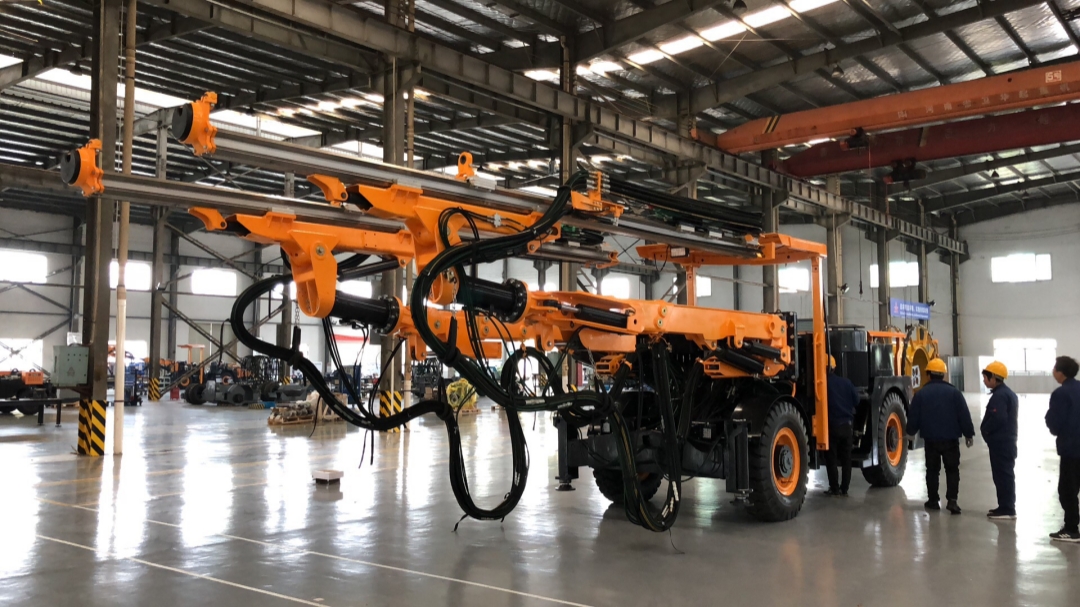
A jumbo drilling rig is mainly used for drilling blast holes and rock-bolting holes in underground mines and tunnels. Also called a drilling jumbo or jumbo drill, it typically uses one or more hydraulic booms to position rock drills across the tunnel face. This allows operators to drill multiple holes according to a planned pattern before blasting or ground-support operations. Jumbo drilling rigs are widely used for underground mine development, tunnel excavation, cross-cutting, and rock support. Kaishan’s KJ321-CYTJ45/2 is a two-boom hydraulic tunneling drilling rig designed for tunnel sections from 12 to 45 m².
The main purpose of a jumbo drilling rig is to drill rock efficiently across an underground working face.
Unlike a conventional drilling rig designed for a single borehole, a jumbo is built around the geometry of a tunnel or mine heading. Its booms can move the rock drills to different positions on the face, allowing multiple holes to be drilled during one drilling cycle.
The most common applications include:
Tunnel Blast-Hole Drilling
Before blasting a tunnel face, a series of holes must be drilled according to a planned drilling pattern. Explosives are then loaded into the holes to break the rock and advance the tunnel.
A jumbo drilling rig can position its boom and rock drill accurately across the face, making it suitable for repeated drilling cycles in underground tunnel construction.
Underground Mine Development
Jumbos are also widely used to develop underground mine workings, including headings, drifts, crosscuts, and other access tunnels.
The machine drills the holes required for blasting the next section of rock, allowing the excavation cycle to continue deeper into the mine.
Rock-Bolting and Ground Support
A jumbo drilling rig can also be configured for drilling rock-bolting holes. These holes are used to install rock bolts and other ground-support systems after excavation.
This makes multi-purpose tunneling jumbos useful when a project needs both excavation drilling and support drilling.
Cross-Cut and Sidewall Drilling
The flexible boom system of a jumbo allows drilling in different directions rather than only straight into the tunnel face. This is useful for cross-cutting, sidewall drilling, and other underground excavation requirements.
The exact drilling coverage depends on the boom geometry, feed length, tunnel dimensions, and selected rock drill.
The main advantage of a jumbo is its ability to cover a large drilling area from one machine position.
A conventional drill may need to be repositioned repeatedly to cover different parts of a tunnel face. A multi-boom jumbo can position several rock drills across the face, which makes it more suitable for repeated drilling cycles in medium and large underground headings.
Jumbos are also designed specifically for underground mobility. Articulated chassis, four-wheel drive, compact dimensions, and climbing capability allow them to move through confined and uneven underground passages.
For example, the Kaishan KJ321-CYTJ45/2 uses a four-wheel-drive articulated chassis and two drilling booms. Its working range covers tunnel sections from 12 to 45 m², making it suitable for a range of underground excavation sizes.
The KJ321-CYTJ45/2 is a two-boom hydraulic tunneling drilling rig designed for underground excavation and drilling support.
It can be configured with HC50 or HC95LMW/RD 22U rock drills. Depending on the selected configuration, the drilling diameter is 32–76 mm or 42–102 mm.
Its two booms have 360° beam rotation, while the feed and boom extension systems allow the drills to reach different areas of the working face.
|
Tunnel |
Tunnel section |
12–45 m² |
|
Operating range |
3×4–7.3×6.5 m²; 4×4–8.7×7.8 m²; 4×4–11.5×9.2 m² |
|
|
Drilling |
Number of booms |
2 |
|
Drilling diameter |
Φ32–76 mm / Φ42–102 mm |
|
|
Rock drill |
2×HC50 / 2×HC95LMW/RD 22U |
|
|
Beam |
Beam rotation |
360° |
|
Feed extension |
1,600 mm |
|
|
Boom extension |
1,200 mm |
|
|
Machine |
Length |
12,000 mm |
|
Width |
2,160 mm |
|
|
Height |
2,500 / 3,300 mm |
|
|
Weight |
Approx. 22,000 kg |
|
|
Mobility |
Tramming speed |
10 km/h |
|
Maximum climbing capacity |
25% (14°) |
|
|
Power |
Diesel engine |
Cummins QSB3.9-C125, 93 kW |
|
Motor |
2×45 kW / 2×75 kW |
|
|
Air & Water System |
Air compressor capacity |
1.55 m³/min |
|
Air pressure |
8 bar |
|
|
Water pump capacity |
10 m³/h |
|
|
Electrical |
Working voltage |
380 V |
|
Frequency |
50 Hz |
The combination of two booms and a 12–45 m² working range is particularly relevant when a project requires broad face coverage rather than single-hole drilling.
The main difference is the drilling coverage and intended excavation method.
A conventional underground drill may be designed for a more specific drilling task, such as long-hole drilling, rock bolting, or a particular type of production drilling. A jumbo is generally designed around the tunnel or mine face and is particularly suited to drilling multiple holes for development and blasting.
|
Feature |
Jumbo Drilling Rig |
Conventional Underground Drill |
|
Main purpose |
Face drilling and development |
Depends on machine type |
|
Number of booms |
Usually one or more |
Often one drilling unit |
|
Face coverage |
Broad |
More limited or application-specific |
|
Blast-hole drilling |
Yes |
Depends on configuration |
|
Rock-bolting holes |
Some configurations |
Depends on configuration |
|
Underground mobility |
Designed for confined spaces |
Varies by model |
|
Typical applications |
Tunneling and mine development |
Production, exploration, bolting, long-hole drilling, etc. |
The choice should therefore be based on the actual underground drilling cycle rather than the machine name alone.
Start with the tunnel or mine heading size. The rig must physically fit through the access route while still providing enough drilling coverage for the working face.
Next, check the required hole diameter and drilling depth. These determine the suitable rock drill, feed system, and drilling tools.
The number of booms is another important consideration. A single-boom jumbo can be suitable for smaller headings, while a two-boom configuration can provide broader face coverage and allow multiple drilling positions to be handled from one machine location.
Underground mobility is equally important. Check the machine width, height, turning configuration, tramming speed, and climbing capacity against the actual underground conditions.
Finally, consider whether the machine will only drill blast holes or also be used for rock bolting and other support operations. A more flexible configuration can be useful when the same machine needs to perform multiple drilling tasks.
Kaishan manufactures underground drilling equipment for tunneling, mine development, rock bolting, scaling, and other underground applications. Its underground drilling range includes hydraulic tunneling drilling rigs as well as mining and rock-bolting equipment.
The KJ321-CYTJ45/2 is one example of a two-boom hydraulic jumbo designed for tunnel sections from 12 to 45 m². For a specific project, the tunnel cross-section, rock conditions, required hole diameter, drilling pattern, and intended application should be considered before selecting the final configuration.
A jumbo drilling rig is mainly used for drilling blast holes and rock-bolting holes in underground mines and tunnels. It is designed to cover a tunnel or mine face using one or more drilling booms.
Yes. Jumbo drilling rigs are commonly used for tunnel excavation where drilling and blasting is required, particularly in hard-rock tunneling.
Yes. Depending on its configuration, a jumbo can drill holes for rock bolts and other ground-support systems in addition to blast holes.
A two-boom jumbo has two independently positioned drilling booms, allowing two rock drills to operate across the working face. This provides broader drilling coverage than a single-boom configuration.
The Kaishan KJ321-CYTJ45/2 is designed for tunnel sections from 12 to 45 m², with several operating-range configurations.
Depending on the selected rock-drill configuration, the KJ321-CYTJ45/2 can drill holes from Φ32–76 mm or Φ42–102 mm.
