 English
 Español
 Русский

A tunneling drilling rig uses hydraulic power, rock drills, and movable booms to drill blast holes and rock-bolting holes in underground tunnels and mines. The rig is positioned inside the tunnel, its booms are adjusted to cover the required drilling area, and the rock drills create holes according to the planned drilling pattern. Modern hydraulic tunneling drilling rigs can also handle vertical, inclined, and horizontal drilling, making them suitable for different stages of underground excavation and ground support.
The drilling process starts with positioning the rig at the required location in the tunnel. Because underground tunnels often have limited space, the chassis and boom system need to provide enough mobility for the machine to reach the drilling position without requiring excessive repositioning.
Once the rig is in position, the operator adjusts the drilling booms and feeds so that the rock drills reach the required points on the tunnel face. A multi-boom rig can cover a wider drilling area from one machine position, which is one of the main reasons jumbo drilling rigs are widely used for underground excavation.
The rock drill then applies impact energy and rotation to the drill rod and bit. The impact breaks the rock while rotation helps the bit continuously penetrate the formation. Drilling parameters such as feed, impact, and rotation are controlled through the hydraulic drilling system.
After the required holes are drilled, the booms are retracted and the rig can be repositioned for the next drilling cycle. Depending on the project, the same rig can also be used for rock-bolting holes and lateral cross-cut drilling.
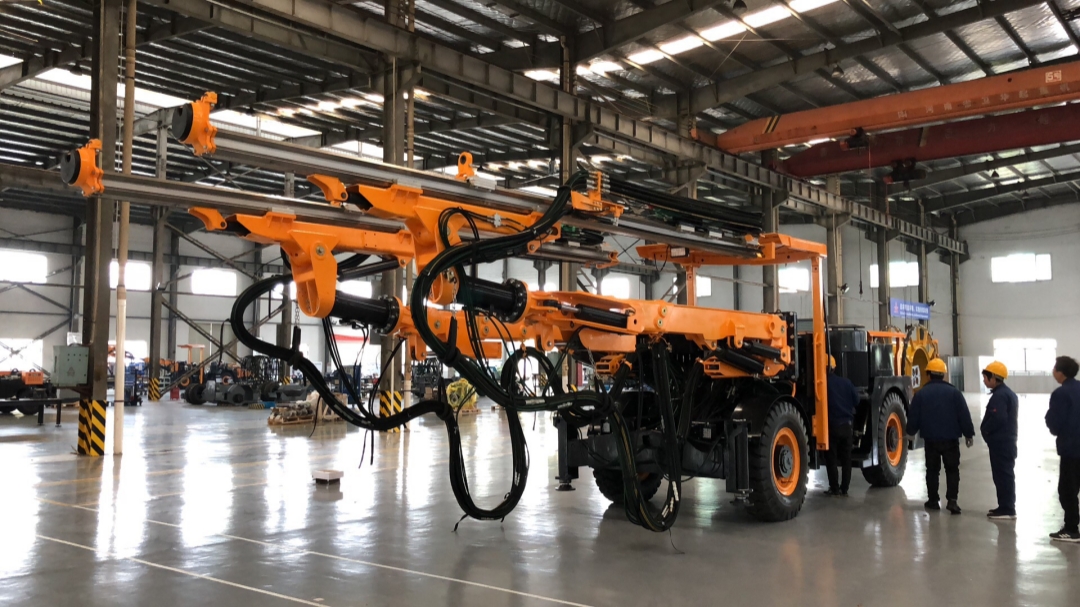
A tunneling drilling rig is made up of several systems that work together during the drilling cycle.
Drilling booms position the rock drills across the tunnel face. On a two-boom jumbo, the booms can operate in different areas of the face, allowing multiple holes to be drilled from one machine position.
Rock drills provide the impact energy needed to break hard rock. Different rock drill configurations can be selected according to the required drilling diameter and drilling conditions.
Feed beams guide the drill rods and control the drilling stroke. A self-leveling beam and 360° rotation can make drill positioning easier when the drilling pattern covers different areas of the tunnel face.
Hydraulic and electric power systems provide the power needed for drilling, boom movement, positioning, and other machine functions.
The chassis allows the rig to move through the tunnel. An articulated four-wheel-drive chassis can improve maneuverability in narrow underground spaces.
A typical tunneling drilling cycle can be divided into several basic steps:
Position the rig at the planned drilling location.
Set the drilling booms according to the tunnel face and hole pattern.
Position the rock drills at the required drilling points.
Drill the holes using impact and rotation from the hydraulic rock drills.
Move to the next drilling position when the required holes are completed.
Repeat the cycle for the next excavation round or rock-bolting operation.
The exact drilling pattern depends on the tunnel design, rock conditions, excavation method, and blasting requirements. The rig itself provides the positioning and drilling capability needed to execute that pattern efficiently.
A two-boom tunneling drilling rig can cover more of the tunnel face from a single machine position than a single-boom configuration. The two booms can be positioned independently, allowing drilling operations to cover different areas of the face.
For example, the Kaishan KJ321-CYTJ45/2 uses two flexible booms with 360° beam rotation and self-leveling beams. Its operating range covers tunnel sections from 12 to 45 m², and it can be used for blast-hole and rock-bolting drilling in vertical, inclined, and horizontal directions.
The KJ321-CYTJ45/2 can be configured with two HC50 rock drills or two HC95LMW/RD 22U rock drills. Depending on the configuration, the drilling diameter ranges from Φ32–76 mm or Φ42–102 mm.
|
Model & Drilling |
Model |
KJ321-CYTJ45/2 |
|
Tunnel section |
12–45 m² |
|
|
Operating range |
3×4–7.3×6.5 m²; 4×4–8.7×7.8 m²; 4×4–11.5×9.2 m² |
|
|
Rock Drill & Boom |
Number of booms |
2 |
|
Rock drill |
2×HC50 / 2×HC95LMW/RD 22U |
|
|
Drilling diameter |
Φ32–76 mm / Φ42–102 mm |
|
|
Beam rotation |
360° |
|
|
Feed & Boom |
Feed extension |
1,600 mm |
|
Boom extension |
1,200 mm |
|
|
Boom type |
K 26F, self-leveling |
|
|
Machine Dimensions |
Length |
12,000 mm |
|
Width |
2,160 mm |
|
|
Height |
2,500 / 3,300 mm |
|
|
Weight |
Approx. 22,000 kg |
|
|
Tramming speed |
10 km/h |
|
|
Mobility |
Maximum climbing capacity |
25% (14°) |
|
Diesel engine |
Cummins QSB3.9-C125, 93 kW, 2200 rpm |
|
|
Power System |
Motor |
2×45 kW / 2×75 kW |
|
Working voltage |
380 V |
|
|
Air, Water & Hydraulic System |
Air compressor capacity |
1.55 m³/min |
|
Air pressure |
8 bar |
|
|
Water pump capacity |
10 m³/h |
|
|
Hydraulic oil tank |
400 L |
|
|
Electrical |
Frequency |
50 Hz |
The KJ321-CYTJ45/2 is designed for tunnel sections of 12–45 m² and combines two-boom drilling, articulated four-wheel drive, and hydraulic positioning for underground drilling applications. Its lifting safety roof meets FOPS and ROPS requirements.
Tunneling drilling rigs are mainly used for drilling blast holes during underground excavation. The holes are drilled according to a planned pattern before blasting, helping create the required tunnel profile.
They can also be used for rock-bolting holes and lateral cross-cut drilling. This makes a hydraulic tunneling drilling rig useful not only for excavation but also for underground ground-support operations.
For larger tunnel sections, a two-boom jumbo such as the KJ321-CYTJ45/2 can provide wider drilling coverage and flexible positioning. For smaller tunnel sections, Kaishan also offers other underground drilling models with different operating ranges, allowing the machine configuration to be matched to the tunnel size.
Kaishan provides a range of underground drilling rigs for different tunnel sections and drilling requirements, including hydraulic tunneling drilling rigs, mining drilling rigs, rock-bolting rigs, and scaling rigs.
The KJ321-CYTJ45/2 is one of the larger two-boom models, covering tunnel sections from 12 to 45 m². With different rock drill configurations, flexible boom positioning, and a four-wheel-drive articulated chassis, it is designed for demanding underground tunneling and mining applications.
If you are selecting a tunneling drilling rig, the key factors to confirm are tunnel section, drilling diameter, required drilling pattern, number of booms, rock conditions, and underground access conditions. Kaishan can recommend a suitable configuration based on these project requirements.
A tunneling drilling rig drills blast holes and rock-bolting holes in underground tunnels and mines. Depending on the configuration, it can drill vertical, inclined, and horizontal holes.
A jumbo drilling rig uses hydraulic rock drills to apply impact and rotation to the drill rod and bit. The impact breaks the rock while the rotating bit penetrates the formation.
A two-boom tunneling drilling rig has two independently positioned drilling booms. This allows the machine to cover a larger section of the tunnel face from one position.
The KJ321-CYTJ45/2 is designed for tunnel sections from 12 to 45 m².
Yes. The KJ321-CYTJ45/2 can be used for rock-bolting holes as well as blast holes, including lateral cross-cut and other underground drilling applications.
