 English
 Español
 Русский

A portable water well drilling rig is a drilling machine designed to be transported and deployed easily at different well construction sites. Compared with large truck-mounted drilling rigs, portable models generally have a more compact structure and flexible mobility, making them suitable for projects where access, transportation, or working space is limited. Depending on the configuration, a portable water well drilling rig can use DTH drilling or mud pump drilling to handle different geological conditions. The Kaishan KW260A, for example, combines a wheel-mounted chassis with hydraulic drilling and supports drilling depths of up to 260 m.
A portable water well drilling rig is designed to simplify transportation and setup between drilling locations. Its structure and mobility system allow it to be moved more conveniently than many large, fixed or heavy drilling systems, particularly on projects involving multiple well sites.
Portable does not necessarily mean that a rig has a low drilling capacity. The actual drilling depth, hole diameter, and formation capability depend on the machine’s power, hydraulic system, drill pipes, drilling method, and other equipment configurations.
The Kaishan KW260A is a wheel-mounted water well drilling rig with a compact overall dimension of 4,000 × 1,800 × 2,350 mm and a machine weight of 5,600 kg. It is designed for water well construction and can be configured for either DTH drilling or mud pump drilling, depending on site conditions.
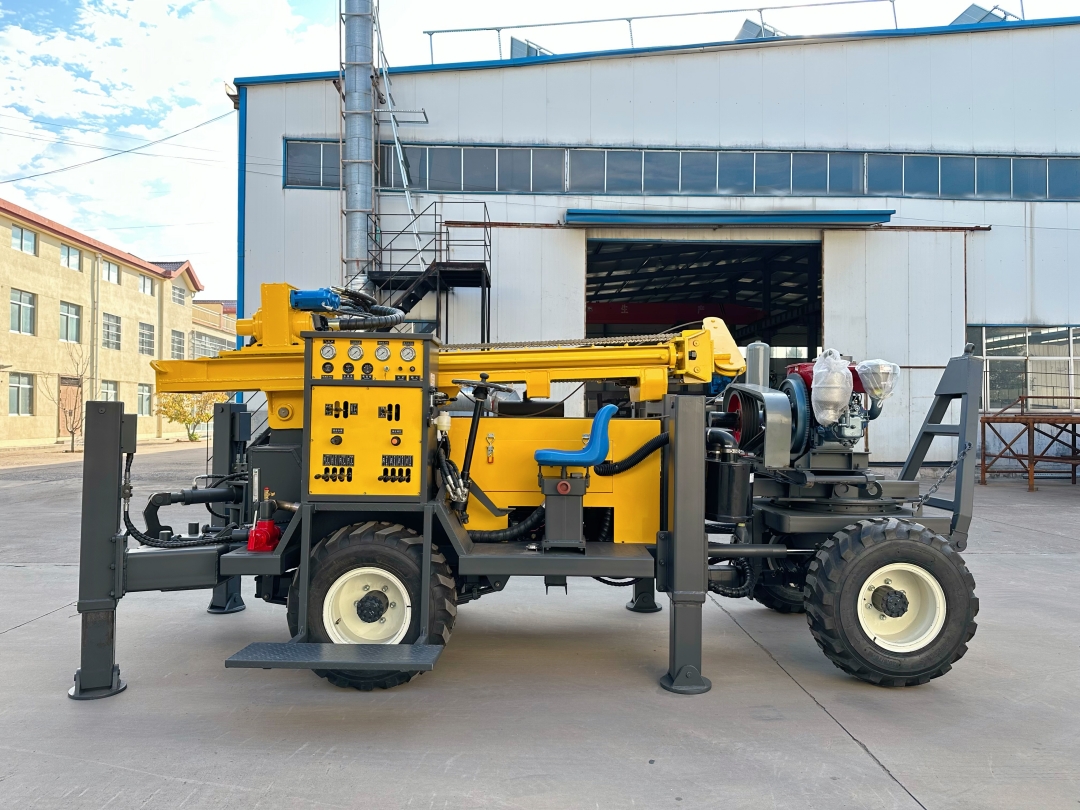
A portable water well drilling rig uses a rotary system and feed mechanism to drive the drill pipe and bit into the ground. The drilling method depends on the formation and the selected configuration.
For DTH drilling, compressed air powers a down-the-hole hammer positioned near the drill bit. The hammer delivers repeated impacts to break hard rock, while compressed air helps remove cuttings from the borehole.
For mud pump drilling, drilling fluid is circulated through the drill pipe and returns with cuttings, helping remove drilled material from the borehole. This method can be suitable for soil, sand, and certain mixed formations, depending on ground conditions and the drilling setup.
The KW260A uses a top-drive hydraulic rotary and propulsion system. It supports DTH drilling with 4-inch, 5-inch, 6-inch, and 8-inch hammers, as well as mud pump drilling. This flexibility allows the rig to be configured for different water well projects.
One of the main advantages of a portable rig is transportation flexibility. A compact or wheel-mounted structure can make it easier to relocate between sites, especially when projects involve multiple drilling locations or limited access.
Portable rigs can also simplify site deployment. Their dimensions and integrated systems can reduce the space required for transportation and positioning, which is useful in agricultural areas, rural communities, and other locations where a large drilling machine may be difficult to accommodate.
Another advantage is configuration flexibility. Some portable water well drilling rigs support different drilling methods, allowing contractors to select DTH drilling or mud pump drilling according to the formation. This can be particularly useful when geological conditions vary between project locations.
However, portability should be considered alongside drilling capacity. Buyers still need to check the required hole diameter, drilling depth, air supply, lifting capacity, and mobility conditions before selecting a machine.
Portable water well drilling rigs are used in projects where transportation and flexible deployment are important.
In agricultural water supply projects, a portable rig can be moved between different well locations to support irrigation and groundwater development. For rural and domestic water supply, its mobility can be useful when drilling sites are spread across a wide area or located away from major roads.
Portable rigs can also be used for general engineering and geological drilling. Depending on the machine’s drilling capacity and configuration, they can handle different formations, including soil, sand, mud, and rock.
The Kaishan KW260A is designed for water well construction, agriculture, domestic water supply, and general engineering applications. Its drilling diameter ranges from Φ140 to 305 mm, with a maximum drilling depth of 260 m.
Portable and truck-mounted water well drilling rigs are both designed to support flexible transportation, but they differ in chassis design, mobility, and typical project requirements.
|
Feature |
Portable Water Well Drilling Rig |
Truck-Mounted Water Well Drilling Rig |
|
Main design focus |
Flexible transportation and site deployment |
Integrated drilling system and road transportation |
|
Chassis |
Compact wheel-mounted or other portable configuration |
Truck or specialized vehicle chassis |
|
Transportation |
Depends on machine design and transport arrangement |
Often travels between sites using its own truck chassis |
|
Site access |
Useful where compact dimensions are important |
Requires suitable road and site access |
|
Typical project |
Rural wells, agricultural water supply, and dispersed drilling sites |
Projects involving frequent road travel between locations |
|
Drilling capacity |
Depends on model and configuration |
Depends on model and configuration |
The distinction is not simply about drilling depth or machine size. A portable rig is generally selected for its transportation and deployment flexibility, while a truck-mounted rig is designed around an integrated vehicle chassis for road-based mobility.
The Kaishan KW260A is a wheel-mounted hydraulic water well drilling rig designed for projects requiring flexible relocation and versatile drilling configurations. Its hydraulic-driven system controls drilling speed, torque, and feed pressure, while the machine can be configured with a mud pump or an air drilling setup according to geological conditions.
With a maximum drilling depth of 260 m and a drilling diameter range of Φ140–305 mm, the KW260A can support a range of shallow to medium-depth water well projects. Its 70 kW Yiqi diesel engine provides the power required for the drilling and hydraulic systems.
|
Parameter |
Specification |
|
Model |
KW260A |
|
Maximum drilling depth |
260 m |
|
Drilling diameter |
Φ140–305 mm |
|
Advance length per cycle |
3.4 m |
|
Working pressure |
1.7–3.0 MPa |
|
Air consumption |
15–31 m³/min |
|
Drill pipe length |
1.5 / 2 / 3 m |
|
Drill pipe diameter |
Φ76 / Φ89 / Φ102 mm |
|
Lifting force |
20 T |
|
Rotary torque |
4,200–5,600 N·m |
|
Rotary speed |
40–70 r/min |
|
Diesel engine |
Yiqi |
|
Engine power |
70 kW |
|
Travelling speed |
0–2.5 km/h |
|
Climbing capacity |
30° |
|
Weight |
5,600 kg |
|
Dimensions (L × W × H) |
4,000 × 1,800 × 2,350 mm |
|
Drilling methods |
DTH drilling / mud pump drilling |
|
DTH hammer options |
4″, 5″, 6″, 8″; CIR110, 130, 150, 170 |
The drilling method and auxiliary equipment should be selected according to the formation, hole diameter, and required drilling depth. For DTH applications, the hammer and compressed-air supply need to be matched to the drilling conditions.
The first consideration is the required drilling depth and hole diameter. These determine the drilling system, drill pipe, and power requirements. A rig should have sufficient capacity for the planned well specifications, with the geological conditions taken into account.
The second consideration is the formation. Soil, sand, mixed formations, and hard rock can require different drilling methods. A rig that supports both DTH and mud pump drilling, such as the KW260A, can offer more configuration flexibility across varying conditions.
Transportation and site access are also important. Buyers should consider the machine’s dimensions, weight, travelling system, access routes, and available space for positioning and drilling. A portable rig may be convenient for relocation, but the transport arrangement still needs to suit the project.
Finally, check the required air capacity, working pressure, lifting force, and available accessories. These factors affect the complete drilling setup and should be evaluated together rather than choosing a rig based on drilling depth alone.
Kaishan provides water well drilling rigs in different configurations to support a range of drilling depths, hole diameters, and site conditions. The KW260A combines a wheel-mounted chassis with a hydraulic drilling system and supports both DTH and mud pump drilling.
For contractors working across multiple well sites, the machine’s compact dimensions and integrated design can help simplify relocation and deployment. Its drilling capacity and configuration options also allow it to serve agricultural water supply, domestic water well construction, and general engineering applications.
Kaishan can help customers match the drilling rig, drilling method, and auxiliary equipment to the project’s geological conditions, well specifications, and transportation requirements.
A portable water well drilling rig is a machine designed for convenient transportation and deployment at different well construction sites. Depending on the model, it can support different drilling depths, hole diameters, and drilling methods.
Yes. Some portable water well drilling rigs support DTH drilling, which uses a pneumatic hammer to break rock. The suitable hammer, air supply, and drilling configuration depend on the formation and required hole diameter.
The Kaishan KW260A has a maximum drilling depth of 260 m and a drilling diameter range of Φ140–305 mm.
Yes. The KW260A supports DTH drilling and mud pump drilling. The appropriate setup depends on the geological conditions and project requirements.
A portable rig is designed around flexible transportation and site deployment, often with a more compact chassis. A truck-mounted rig integrates the drilling system with a truck or specialized vehicle chassis for road transportation. The right configuration depends on site access, relocation needs, and drilling requirements.
Key factors include drilling depth, hole diameter, geological conditions, drilling method, air supply, lifting capacity, machine dimensions, and transportation requirements. These factors should be evaluated together to select a rig suitable for the project.
