 English
 Español
 Русский

RC drilling, or reverse circulation drilling, is mainly used for mineral exploration, open-pit mining, ore sampling, and geological prospecting. It allows drilling teams to collect rock cuttings continuously from different depths, helping geologists evaluate underground formations and identify areas with mineral potential. Compared with conventional drilling methods, RC drilling is particularly useful when reliable samples and efficient exploration are important. The right RC drilling rig depends on the required drilling depth, hole diameter, geological conditions, and the scale of the exploration project.
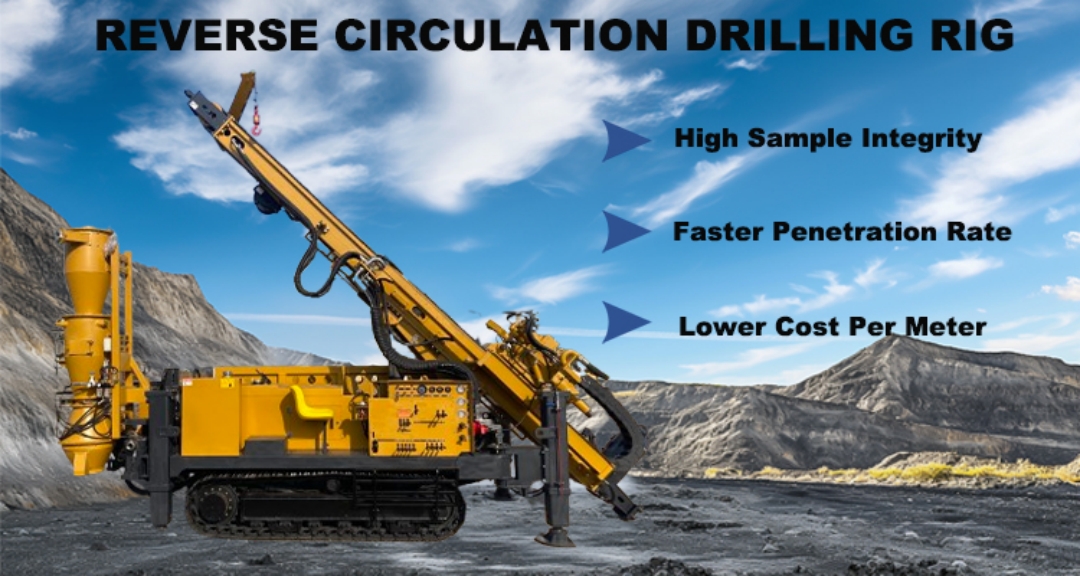
Mineral exploration is one of the main applications of reverse circulation drilling. Before developing a mine, exploration teams need information about the rock formations and the possible distribution of valuable minerals underground.
An RC drilling rig collects rock cuttings as drilling progresses. Geologists can examine these samples at different depths to understand the formation and identify areas that may require further investigation. This makes RC drilling a practical option for early-stage exploration and follow-up drilling programs.
RC drilling is widely used in open-pit mineral exploration and mining projects. It can help exploration teams investigate mineralized zones beneath and around an existing or planned pit.
The collected samples provide information for geological assessment and help teams decide where additional exploration may be needed. For projects involving multiple boreholes, drilling efficiency and consistent sample collection are important considerations when selecting equipment.
Ore sampling and grade testing are important when evaluating a mineral deposit. Samples collected during drilling can be analyzed to estimate mineral content and understand how it changes with depth and location.
Because reverse circulation drilling transports cuttings through the inner tube of a double-wall drill pipe, it helps reduce contact between returning samples and material circulating outside the inner tube. Proper sampling procedures and equipment setup are still necessary to maintain sample quality.
RC drilling is also used to investigate subsurface geology in areas where the geological structure is not fully understood. Samples from different depths help geologists identify changes in rock type and evaluate potential mineral-bearing formations.
The information can guide further exploration, including additional RC drilling or core drilling when more detailed geological information is required.
RC drilling combines drilling with continuous rock-cuttings collection. This makes it suitable for exploration programs that need to evaluate multiple boreholes efficiently.
Its main advantages include:
Continuous sample collection: Rock cuttings can be collected throughout drilling, providing information from different depths.
Efficient drilling: Compressed air helps transport cuttings through the inner drill pipe, reducing the need for conventional mud circulation in suitable formations.
Reduced sample contamination: The dedicated return path helps limit contact between the recovered cuttings and surrounding drilling fluid.
Practical exploration setup: RC drilling can be used for mineral sampling and geological investigation across a range of open-pit exploration projects.
Actual drilling speed and sample quality depend on formation conditions, hole diameter, air supply, drill bits, and operating procedures. Loose or fractured formations may require additional measures to maintain borehole stability and sample recovery.
RC drilling and core drilling are both used in mineral exploration, but they provide different types of geological samples.
|
Comparison |
RC Drilling |
Core Drilling |
|
Sample type |
Rock cuttings |
Cylindrical rock core |
|
Main purpose |
Mineral sampling and grade evaluation |
Detailed geological investigation |
|
Sample information |
Material collected from the drilled interval |
Rock structure, texture, and mineral relationships preserved in the core |
|
Typical use |
Exploration programs requiring efficient sampling across multiple holes |
Projects requiring detailed geological records |
|
Common equipment |
RC300, RC500 |
JY300 and other core drilling rigs, depending on project requirements |
RC drilling is often a practical choice when exploration teams need to collect samples efficiently across many boreholes. Core drilling is more suitable when intact rock samples are needed to examine structures, fractures, and geological relationships in detail.
These methods are not mutually exclusive. A project may use RC drilling to investigate a large area and then use core drilling to study selected locations in greater detail.
The first consideration is the required drilling depth. A rig must be capable of reaching the planned depth under the expected geological conditions, rather than simply matching the maximum depth stated in its specifications.
Hole diameter is another important factor because it affects the drilling system, drill pipe, and air requirements. Buyers should also consider formation conditions, sample collection requirements, mobility between boreholes, and the availability of suitable drill tools and accessories.
For example, Kaishan offers two reverse circulation drilling rigs for different drilling requirements:
|
Technical Parameter |
RC300 |
RC500 |
|
Maximum drilling depth |
300 m |
500 m |
|
Maximum drilling diameter |
Φ350 mm |
Φ400 mm |
|
Rated power |
92 kW |
132 kW |
|
Lifting force |
20 T |
28 T |
|
Machine weight |
8 T |
10.5 T |
The RC300 is worth considering for projects within its drilling capacity, while the RC500 offers greater maximum drilling depth and hole diameter. Final selection should also account for the actual drilling conditions and the configuration required for the project.
Kaishan offers the RC300 and RC500 reverse circulation drilling rigs for mineral exploration, open-pit mineral sampling, ore grade testing, and geological prospecting.
The RC300 provides a maximum drilling depth of 300 m, with a maximum drilling diameter of Φ350 mm. For projects requiring greater drilling capacity, the RC500 reaches a maximum drilling depth of 500 m and supports drilling diameters up to Φ400 mm.
Choosing between the two models depends on the planned borehole depth, diameter, geological conditions, and operating requirements. Contact Kaishan with your project details to discuss a suitable reverse circulation drilling solution.
RC drilling is mainly used for mineral exploration, open-pit mineral sampling, ore grade testing, and geological prospecting. It is particularly useful when teams need to collect rock cuttings continuously during drilling.
Yes. RC drilling is widely used in mineral exploration because it provides samples from different depths and supports efficient investigation of potential mineral deposits. The appropriate method depends on the geology and the level of detail required.
RC drilling collects rock cuttings through the inner tube of a double-wall drill pipe. Core drilling recovers cylindrical rock samples that preserve more of the rock’s original structure. RC drilling is often selected for efficient sampling, while core drilling is used when detailed geological examination is required.
The maximum drilling depth depends on the model and drilling conditions. The Kaishan RC300 has a maximum drilling depth of 300 m, while the RC500 has a maximum drilling depth of 500 m.
The RC300 may suit projects within its 300 m maximum drilling depth and Φ350 mm maximum drilling diameter. The RC500 offers a maximum drilling depth of 500 m and a maximum drilling diameter of Φ400 mm. The final choice should be based on your project requirements and site conditions.
