 English
 Español
 Русский

A truck-mounted water well drilling rig is a drilling machine installed on a truck or special chassis, combining the drilling system, power system and transportation platform into one mobile unit. It is mainly used for water well drilling, geological exploration and other borehole projects where the equipment needs to move between different locations. Compared with a crawler-mounted rig, its biggest advantage is convenient road transportation. For contractors handling multiple drilling sites, a truck-mounted water well drilling rig can provide a practical combination of drilling capability and mobility.
A truck-mounted water well drilling rig integrates the drilling equipment with a truck or special-purpose chassis. Instead of transporting the drilling machine separately, the complete unit can travel between accessible drilling locations.
A typical truck-mounted rig integrates the drilling rig, engine, hydraulic system, mud or air circulation system, winch and other auxiliary equipment into the chassis. This creates a relatively compact drilling system while keeping the machine mobile.
The exact configuration varies between models. Some are mainly designed for rotary drilling, while others can use air drilling or pneumatic impact systems for harder formations.
For example, the Kaishan KWMT800 Mounted Truck Well Drilling Rig integrates the drilling rig, power, mud/air circulation, winch and hydraulic system into its chassis. The manufacturer lists a maximum drilling depth of 800 m and a hole diameter range of 140–400 mm.
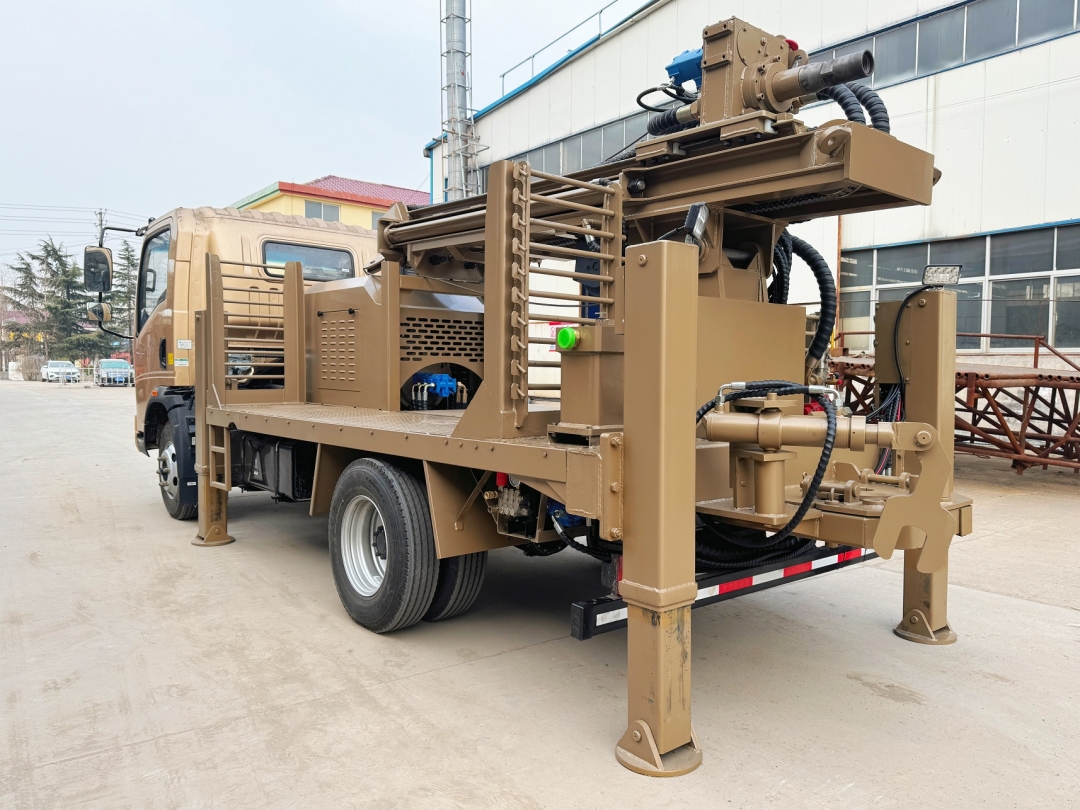
The drilling process depends on the drilling method and geological formation.
During rotary drilling, the power system drives the drill pipe and drilling tool while the rig applies the required feed force. Drilling fluid or air can be circulated through the borehole to help cool the drilling tool and remove cuttings.
For harder formations, a rig configured for pneumatic impact drilling can use compressed air to operate the impact system and improve rock breaking.
The drilling depth, hole diameter, formation, drilling method and flushing system all affect the final drilling configuration. This is why a water well rig should be selected according to the actual borehole requirements rather than simply its maximum depth.
The primary application is water well drilling, but truck-mounted rigs can also be used for several other borehole projects.
For agricultural projects, they can be used to drill wells for irrigation and groundwater supply. In rural areas, the same type of equipment can be used for community water wells where the drilling locations are connected by roads.
Truck-mounted rigs are also used for geological exploration and prospecting boreholes. Depending on the machine configuration, they can also support certain auxiliary drilling operations.
The Kaishan KWMT800, for example, is listed for mine engineering, geological exploration, prospecting boreholes and underground auxiliary drilling operations in addition to its water well drilling applications.
The main reason to choose a truck-mounted configuration is mobility between drilling sites.
If a contractor needs to drill multiple wells in different locations with reasonable road access, having the drilling system mounted directly on a truck or special chassis can make relocation more convenient.
The chassis also provides the platform for the drilling system, while hydraulic leveling legs help stabilize the rig during drilling. On the KWMT800, hydraulic leg leveling is part of the standard configuration, and the manufacturer describes the machine as using an integrated chassis and centralized controls.
However, truck-mounted does not mean suitable for every terrain. If the drilling location is far from roads or requires extensive movement over rough ground, a crawler-mounted water well drilling rig may be more appropriate.
The two configurations are designed around different mobility requirements.
|
Factor |
Truck-Mounted Water Well Drilling Rig |
Crawler Water Well Drilling Rig |
|
Road transportation |
Convenient |
Usually requires separate transport |
|
Relocation between road-accessible sites |
Very practical |
Practical but may require transport |
|
Rough or uneven terrain |
Depends on site access |
Generally more suitable |
|
Multiple drilling locations |
Suitable |
Suitable |
|
Road-connected agricultural projects |
Suitable |
Suitable |
|
Remote or difficult-access sites |
May be limited |
Generally more adaptable |
The right choice depends on the relationship between road access, drilling location, terrain and relocation frequency.
The first factor is drilling depth. Different projects can require very different drilling depths, so the rig should provide sufficient capacity for the target well rather than simply relying on its maximum specification.
The second is hole diameter. A larger borehole requires an appropriate drilling system and tools, and the available diameter range should match the actual well design.
Geological conditions are equally important. Soil, sand, gravel, weathered rock and hard rock can require different drilling methods and tools.
You should also consider the air or mud circulation system, engine power, drill pipe length, climbing capacity and overall machine weight.
For example, the KWMT800 has a maximum drilling depth of 800 m, a 140–400 mm hole diameter range, 153 kW equipped power, 1.7–3.5 MPa air pressure and a maximum climbing angle of 30°. Its listed weight is 21,500 kg.
The KWMT800 is designed as a heavy-duty truck-mounted drilling platform for deeper water well and borehole applications.
Its technical specifications cover several drilling configurations, with listed drilling depths of 180, 200, 300, 400, 500, 600 and 800 m. The hole diameter range is 140–400 mm.
|
Parameter |
KWMT800 |
|
Maximum drilling depth |
800 m |
|
Available drilling depths |
180 / 200 / 300 / 400 / 500 / 600 / 800 m |
|
Hole diameter |
φ140–400 mm |
|
Drill pipe length |
1.5 / 2.0 / 3.0 / 6.0 m |
|
Equipped power |
153 kW |
|
Air pressure |
1.7–3.5 MPa |
|
Climbing capacity |
Max. 30° |
|
Weight |
21,500 kg |
|
Voltage |
24 V |
|
Dimensions (L × W × H) |
6300 × 2300 × 2850 mm |
The KWMT800 also uses an integrated chassis design, centralized controls and hydraulic leveling legs. The manufacturer states that its main operating functions can be controlled from the centralized console.
For projects requiring deeper water wells or larger boreholes, these specifications make the KWMT800 a truck-mounted configuration worth considering when the site has suitable road access and the required drilling conditions match the machine’s capabilities.
Kaishan offers water well drilling rigs covering different drilling depths, hole diameters and machine configurations.
The KWMT800 is positioned toward deeper drilling applications, with a maximum listed depth of 800 m and a 140–400 mm hole diameter range. Other Kaishan water well drilling rigs cover different capacity ranges, allowing the equipment to be selected according to the actual project rather than using one configuration for every well.
For a truck-mounted water well project, the key is to match the rig to the required depth, hole diameter, geological conditions, drilling method and site accessibility.
A truck-mounted water well drilling rig is a drilling machine installed on a truck or special chassis. It combines the drilling system and transportation platform into one mobile unit.
It is mainly used for water well drilling, including agricultural irrigation wells and groundwater supply projects. Depending on the configuration, it can also be used for geological exploration, prospecting boreholes and other drilling applications.
The drilling depth depends on the specific model. The Kaishan KWMT800 has a maximum listed drilling depth of 800 m, with several available depth configurations from 180 m to 800 m.
The KWMT800 has a listed hole diameter range of 140–400 mm.
It depends on the machine configuration. Some truck-mounted rigs can be equipped with pneumatic impact systems or other drilling configurations for harder formations. The drilling method should be selected according to the actual geological conditions.
They are designed for different operating conditions. Truck-mounted rigs emphasize convenient transportation between road-accessible drilling locations, while crawler-mounted rigs generally provide greater mobility directly on rough or uneven terrain.
Consider the required drilling depth, hole diameter, geological conditions, drilling method, air or mud circulation requirements, engine power, drill pipe configuration and site accessibility. The maximum drilling depth alone should not be the only selection criterion.
