 English
 Español
 Русский

DTH drilling is mainly used for drilling holes in hard and fractured rock, especially where reliable rock penetration, controlled hole direction, and relatively large drilling diameters are required. Common applications include mining, quarrying, water well drilling, construction, geotechnical work, and blast-hole drilling. Because the hammer operates directly at the bottom of the borehole, DTH drilling is particularly effective in hard-rock formations and demanding drilling conditions.
DTH stands for Down-the-Hole. In DTH drilling, the hammer is positioned directly behind the drill bit at the bottom of the borehole.
Compressed air travels through the drill pipe to power the hammer. The hammer repeatedly strikes the bit to break the rock, while the returning air helps carry the drilled cuttings out of the hole.
This makes DTH drilling particularly suitable for hard-rock applications where consistent impact performance and effective hole cleaning are important.
DTH drilling is used in several industries, but most applications involve drilling through relatively hard rock.
Mining is one of the most common applications. DTH rigs are used to drill blast holes, pre-splitting holes and other holes required for open-pit mining. The method is well suited to hard and abrasive rock and can provide controlled hole diameters and directions.
Quarrying is another major application. Quarries often need to drill holes for controlled blasting in granite, limestone and other hard formations. DTH drilling can provide the penetration and hole accuracy required for these operations.
Water well drilling is also a common DTH application, particularly in hard-rock formations. The hammer breaks the rock at the bottom of the well while compressed air carries cuttings upward. Different water well rigs can be configured for different drilling depths and diameters.
Construction and geotechnical drilling can also use DTH technology when drilling through hard rock is required. Applications may include foundation-related drilling, anchoring, site investigation and other rock-drilling operations.
|
Application |
Typical Purpose |
|
Mining |
Blast holes, pre-splitting holes and open-pit rock drilling |
|
Quarrying |
Blast holes and bench drilling |
|
Water well drilling |
Drilling through hard-rock formations for water wells |
|
Construction |
Foundation, anchoring and other rock-drilling applications |
|
Geotechnical drilling |
Site investigation and engineering-related rock drilling |
The main reason is the location of the hammer.
Unlike top-hammer drilling, where the impact mechanism remains on the surface, a DTH hammer operates directly at the bottom of the borehole, close to the bit. This allows the hammer to deliver impact energy directly where the rock is being broken.
Compressed air also helps remove cuttings from the hole. Effective flushing keeps the bottom of the borehole clear and allows the bit to continue working on fresh rock.
For this reason, DTH performance depends not only on the hammer and bit, but also on air pressure, air volume, drill pipe and hole-cleaning conditions.
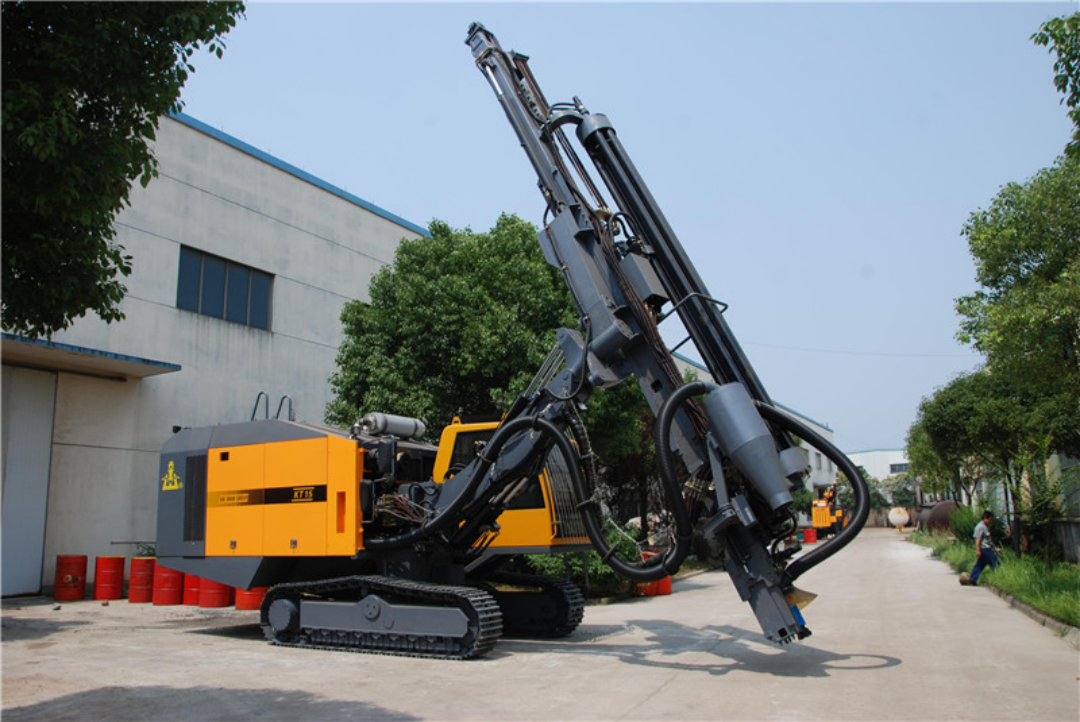
For open-pit mining and quarrying, DTH drilling is commonly used for blast holes and pre-splitting holes.
A typical drilling system needs to balance hole diameter, drilling depth, rock hardness, drilling speed and mobility. The appropriate rig therefore depends on the blasting or drilling requirements rather than simply choosing the largest available machine.
For example, the Kaishan KT15C Integrated Down the Hole Drill Rig is designed for open-pit mining and stonework blast holes and can drill vertical, inclined and horizontal holes. Its official specifications include a drilling diameter of 140–190 mm and an economical drilling depth of 36 m.
|
Parameter |
KT15C |
|
Drilling diameter |
140–190 mm |
|
Economical drilling depth |
36 m |
|
Drilling hardness |
f=6–20 |
|
Engine |
Cummins QSZ13-C400 |
|
Complete machine power |
298 kW |
|
Screw compressor displacement |
22 m³/min |
|
Screw compressor discharge pressure |
24 bar |
|
DTH hammer |
K4, K5, K6 |
|
Drill rod |
φ89/φ102 × 4000 mm |
|
Feed stroke |
4580 mm |
|
Rotary speed |
0–100 r/min |
|
Rotary torque |
4100 N·m |
|
Maximum feed force |
65,000 N |
|
Travelling speed |
3.0 km/h |
|
Climbing capacity |
25° |
|
Weight |
23,800 kg |
The KT15C also uses automatic rod handling, electro-hydraulic anti-sticking control, automatic drill rod lubrication and a floating joint to protect the drill rod threads.
DTH drilling is widely used for water wells in hard-rock areas.
The hammer provides continuous impact at the bottom of the borehole, while compressed air helps remove rock cuttings. This combination makes DTH drilling suitable for formations where conventional rotary drilling may have difficulty maintaining effective rock penetration.
Water well drilling requires a different configuration from open-pit blast-hole drilling. Depth, hole diameter, formation conditions and air requirements are all important when selecting the rig.
DTH drilling can also be used when construction or geotechnical projects require holes through hard rock.
Typical applications include foundation drilling, anchoring and site investigation. The exact rig configuration depends on the required hole diameter, depth, drilling direction and site conditions.
DTH is particularly useful when hard rock makes conventional drilling more difficult, but it is not automatically the right method for every construction project.
DTH rigs can be configured in different ways depending on the working environment.
Integrated DTH drilling rigs combine the drilling system and compressor into one machine. This configuration is commonly used in open-pit mining and quarrying where an integrated and mobile drilling system is required.
Crawler-mounted DTH rigs are designed for sites where mobility over uneven or rough terrain is important.
Truck-mounted DTH rigs combine the drilling system with a truck chassis and are useful when the equipment needs to move between different drilling locations.
The best configuration depends on the application, drilling conditions and required mobility.
Start with the drilling requirements rather than the machine model.
Drilling diameter
Required drilling depth
Rock hardness and formation
Drilling direction
DTH hammer requirements
Air pressure and air consumption
Required mobility
Hole-cleaning requirements
For example, a rig designed for open-pit blast holes may have a very different configuration from a rig intended for deep water well drilling.
The hammer, compressor, drill pipe and rig should be treated as one drilling system.
Kaishan provides integrated DTH drilling rigs, conventional DTH rigs, water well drilling rigs, DTH hammers, drill bits and mobile screw air compressors.
This allows the drilling system to be configured around the actual application rather than selecting the rig separately from the drilling tools and air supply.
For open-pit mining and quarrying, the KT15C provides an integrated DTH solution with a built-in screw compressor and K4/K5/K6 hammer options. For water well drilling, Kaishan also offers different rig configurations designed for different depths and drilling diameters.
DTH drilling is mainly used for drilling hard and fractured rock. Common applications include mining, quarrying, water well drilling, construction, geotechnical drilling and blast-hole drilling.
Yes. DTH drilling is particularly suitable for hard-rock formations because the hammer operates directly behind the drill bit at the bottom of the hole.
Yes. DTH drilling is widely used for water wells in hard-rock formations because the hammer provides effective rock breaking while compressed air helps remove cuttings.
In mining, DTH drilling is commonly used for blast holes, pre-splitting holes and other open-pit rock-drilling applications.
In DTH drilling, the hammer operates at the bottom of the hole near the bit. In top-hammer drilling, the impact mechanism remains at the surface and transfers impact energy through the drill string.
The KT15C has a drilling diameter range of 140–190 mm and an economical drilling depth of 36 m.
Yes, conventional DTH systems require compressed air to operate the hammer and remove cuttings. Integrated DTH rigs such as the KT15C have the screw compressor built into the machine, with the KT15C providing 22 m³/min of air at 24 bar.
Yes. DTH drilling can be used for relatively deep holes, but the appropriate hammer, drill pipe, compressor capacity, drilling diameter and flushing conditions need to be considered together.
