 English
 Español
 Русский

For DTH drilling, the right air compressor depends mainly on the DTH hammer, working pressure, air consumption, and drilling diameter. A compressor that is too small may not provide enough pressure or airflow for stable hammer operation and effective cuttings removal. An oversized compressor, on the other hand, can increase fuel consumption and operating costs. The right approach is to match the compressor to the complete drilling system rather than choosing one simply by engine power.
A DTH hammer uses compressed air to drive its internal piston and break rock at the bottom of the hole. After powering the hammer, the air flows back through the borehole and helps carry drilled cuttings to the surface.
The compressor therefore needs to provide enough pressure for the hammer and enough air volume for continuous drilling and hole cleaning.
Both are important, but they serve different purposes.
Air pressure affects the operation of the DTH hammer, while air volume determines how much air is available for continuous hammer operation and removal of cuttings.
A compressor with sufficient pressure but insufficient airflow may still perform poorly. The same applies to a compressor that provides enough airflow but cannot maintain the required pressure.
This is why DTH compressor selection should always consider pressure and air capacity together.
Start with the DTH hammer. Check the hammer manufacturer’s recommended working pressure and air consumption, then consider the drilling diameter and depth.
As a general reference, a 4-inch DTH hammer may require around 10–13 m³/min, a 5-inch hammer around 14–17 m³/min, and a 6-inch hammer around 17–21 m³/min, depending on the hammer design and operating pressure.
These are only reference ranges. The specifications of the exact hammer being used should be the starting point for compressor selection.
Drill pipe length, air hoses, fittings and drilling depth should also be considered because pressure can be lost along the air path.
Yes. The compressed air must not only operate the hammer but also remove rock cuttings from the hole.
A larger borehole creates a larger space around the drill pipe. If the airflow remains unchanged, the air velocity in this space can decrease, making cuttings removal less effective.
For this reason, a compressor that works well for a smaller DTH hole may not provide the same flushing performance when used for a significantly larger hole.
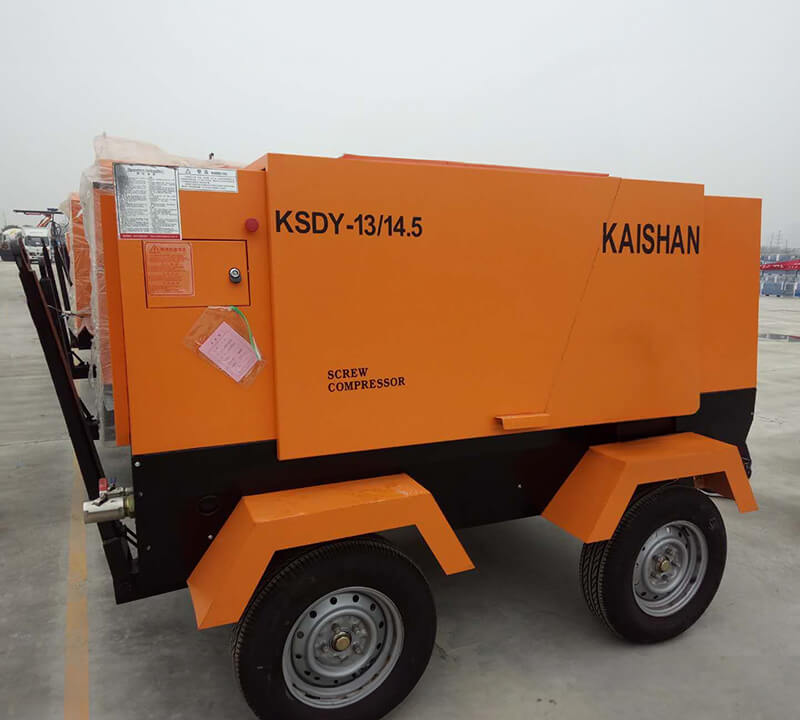
Kaishan’s KSDY Mobile Screw Air Compressor series covers a range of pressure and air-flow requirements for drilling applications.
The series provides discharge pressures from 0.8 to 1.8 MPa, air capacities from 10 to 24 m³/min, and power from 75 to 132 kW.
|
Model |
Discharge Pressure |
Air Capacity |
Power |
|
KSDY-13.6/8 |
0.8 MPa |
13.6 m³/min |
75 kW |
|
KSDY-12.5/10 |
1.0 MPa |
12.5 m³/min |
75 kW |
|
KSDY-10/14.5 |
1.45 MPa |
10 m³/min |
75 kW |
|
KSDY-16.5/8 |
0.8 MPa |
16.5 m³/min |
90 kW |
|
KSDY-13/14.5 |
1.45 MPa |
13 m³/min |
90 kW |
|
KSDY-20/8 |
0.8 MPa |
20 m³/min |
110 kW |
|
KSDY-16.5/12 |
1.2 MPa |
16.5 m³/min |
110 kW |
|
KSDY-24/8 |
0.8 MPa |
24 m³/min |
132 kW |
|
KSDY-18/13 |
1.3 MPa |
18 m³/min |
132 kW |
|
KSDY-15/17 |
1.7 MPa |
15 m³/min |
132 kW |
|
KSDY-22/18-II |
1.8 MPa |
22 m³/min |
132 kW |
|
KSDY-20/18-II |
1.8 MPa |
20 m³/min |
132 kW |
The different configurations allow the compressor to be matched to different drilling requirements. For higher-pressure applications, for example, the KSDY-15/17, KSDY-20/18-II, and KSDY-22/18-II provide working pressures of 1.7–1.8 MPa.
For applications where higher airflow is more important at lower pressure, the KSDY-20/8 and KSDY-24/8 provide air capacities of 20 and 24 m³/min respectively.
An undersized compressor may struggle to maintain the required pressure and airflow during continuous drilling.
This can reduce hammer performance, slow drilling and make cuttings removal less effective. Increasing pressure alone will not solve an insufficient air-volume problem. The compressor needs to provide the right combination of pressure and airflow.
Not necessarily.
Drilling speed also depends on the DTH hammer, drill bit, rock formation and drilling parameters. Supplying more air than the system requires does not automatically increase penetration speed.
The better choice is a compressor with enough capacity to meet the drilling requirements while maintaining a reasonable operating margin.
Kaishan supplies both drilling equipment and mobile screw air compressors, allowing the air supply to be considered together with the drilling system.
The KSDY series offers multiple pressure and airflow configurations, making it easier to match the compressor to different DTH drilling requirements.
For a specific project, Kaishan can help select the appropriate compressor according to the DTH hammer, drilling diameter, required pressure, air consumption and drilling conditions.
The required compressor size depends on the DTH hammer’s air consumption and working pressure, as well as the drilling diameter, depth and air-line losses.
Both are important. Pressure is required for hammer operation, while sufficient air volume is needed for continuous drilling and cuttings removal.
Air consumption varies by hammer design and working pressure. As a general reference, 4-inch, 5-inch and 6-inch DTH hammers may require approximately 10–13, 14–17 and 17–21 m³/min respectively.
The required pressure depends on the DTH hammer. The compressor must maintain the required pressure at the hammer while allowing for pressure losses in the drill pipe and hoses.
The KSDY series provides up to 24 m³/min of air capacity, with maximum discharge pressure reaching 1.8 MPa.
Not necessarily. Compressor capacity needs to match the DTH hammer and complete drilling system. A larger compressor does not automatically mean faster drilling.
