 English
 Español
 Русский

The KT12 integrated DTH drill rig is designed for surface rock drilling in open-pit mines, quarries, and other projects requiring blast-hole drilling. It combines a hydraulic drilling system and a screw air compressor in one machine, reducing the need to transport and connect a separate compressor. The KT12 can drill vertical, inclined, and horizontal holes with diameters of 115–152 mm. With a built-in compressor delivering 20 m³/min of air at 22 bar, it is designed for demanding hard-rock drilling applications within its rated capacity.
The KT12 is primarily designed for surface drilling, particularly where hard rock needs to be drilled before blasting or excavation.
In open-pit mines, the KT12 can drill blast holes in hard-rock formations. These holes are prepared according to the mine’s blasting plan, with drilling diameter and depth determined by the bench height, rock conditions, and blasting requirements.
The rig’s integrated compressor and hydraulic drilling system allow the main drilling equipment to operate as one unit, which can simplify equipment arrangement at the site.
Quarry operations often require repeated drilling in hard rock before blasting and stone extraction. The KT12 supports drilling diameters of 115–152 mm, making it suitable for quarry projects that require holes within this range.
Pre-splitting is used in some blasting operations to create a controlled separation plane in the rock before the main production blast. The KT12 can drill vertical, inclined, and horizontal holes, providing flexibility for different drilling layouts.
The appropriate hole arrangement and drilling parameters should be determined by the project’s blasting design and geological conditions.
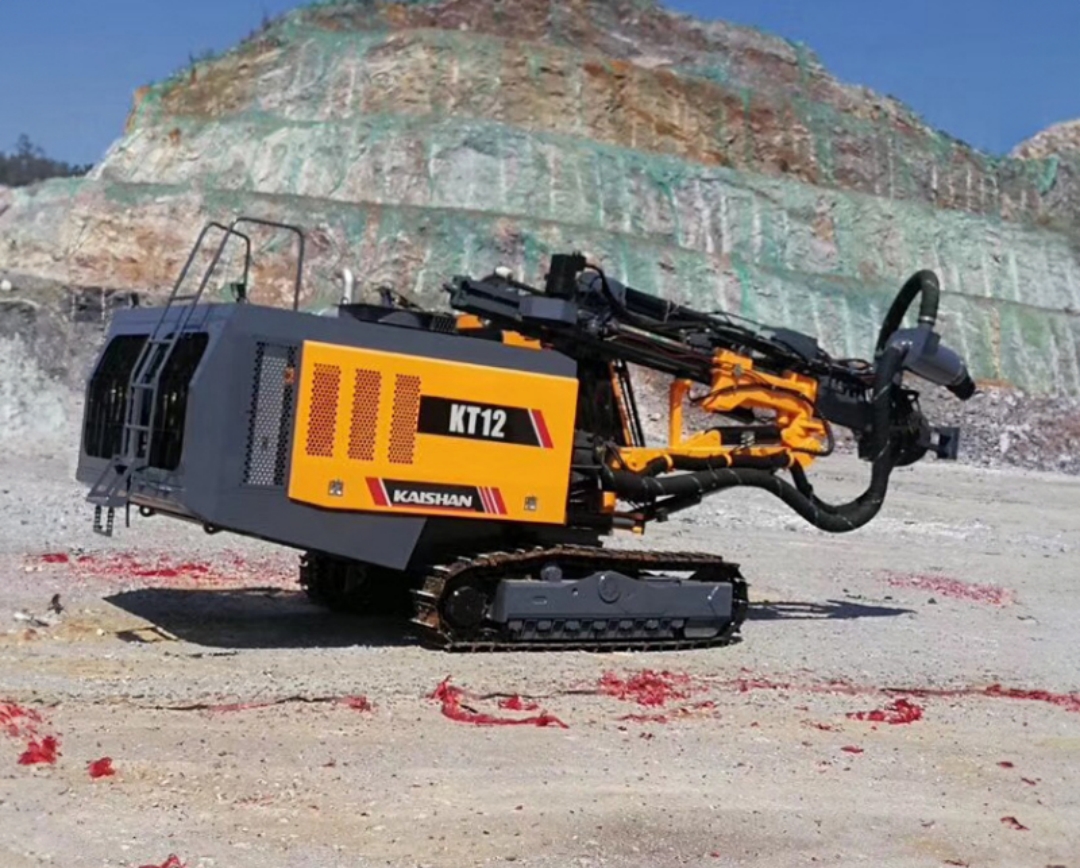
The main feature of an integrated DTH drilling rig is that the drilling system and screw air compressor are installed on the same machine.
A conventional separated setup uses a drilling rig and an independent air compressor connected through air hoses. With an integrated design, the compressor is built into the rig and powered by the machine’s engine.
For the KT12, the Cummins diesel engine provides power for both the screw compression system and the hydraulic transmission system. This arrangement reduces the need to position a separate compressor beside the drilling rig.
The main advantages include:
Integrated equipment layout: The compressor and drilling system are combined in one machine.
Simplified site arrangement: There is no need to position a separate compressor for the built-in air supply.
Flexible drilling direction: The KT12 supports vertical, inclined, and horizontal drilling.
Automatic rod handling: The automatic rod handling system helps reduce manual handling during drilling operations.
Dust collection: An efficient dust-collection system helps control dust generated during rock drilling.
Operator comfort: The cab is designed with air conditioning and a comfortable operating environment.
An integrated design does not mean that every operating cost or maintenance requirement is automatically lower. Buyers should also consider engine maintenance, compressor servicing, fuel consumption, and access to replacement parts.
The KT12 uses a down-the-hole hammer positioned near the drill bit. Compressed air from its built-in screw compressor powers the hammer, producing repeated impacts that break the rock at the bottom of the borehole.
At the same time, the hydraulic rotary system turns the drill string and the feed system advances it into the formation. Compressed air also helps remove rock cuttings from the hole.
The machine uses a Cummins QSL8.9-C360-30 diesel engine rated at 265 kW at 2,200 rpm. Its screw compressor supplies 20 m³/min of air at 22 bar, providing the compressed air required by the DTH hammer.
The KT12 supports K40 and K50 DTH hammers and uses Φ89 × 4,000 mm drill rods. The actual hammer and drilling configuration should be selected according to the required hole diameter and rock conditions.
The following specifications are based on Kaishan’s product information.
|
Parameter |
KT12 |
|
Drilling diameter |
115–152 mm |
|
Economical drilling depth |
28 m |
|
Rock hardness |
f = 6–20 |
|
Engine |
Cummins QSL8.9-C360-30 |
|
Engine power |
265 kW / 2,200 rpm |
|
Screw air compressor |
Zhejiang Kaishan |
|
Air capacity |
20 m³/min |
|
Air pressure |
22 bar |
|
DTH hammer |
K40 / K50 |
|
Drill rod |
Φ89 × 4,000 mm |
|
Number of drill rods |
6+1 |
|
Rotation speed |
0–100 rpm |
|
Rotary torque |
3,450 N·m |
|
Maximum propelling force |
25 kN |
|
Feed stroke |
4,490 mm |
|
Compensation stroke |
1,353 mm |
|
Travelling speed |
0–3 km/h |
|
Climbing capacity |
25° |
|
Ground clearance |
420 mm |
|
Transport dimensions (L × W × H) |
9,830 × 2,580 × 3,320 mm |
|
Machine weight |
17,500 kg |
With a 115–152 mm drilling diameter range and an economical drilling depth of 28 m, the KT12 is intended for surface drilling projects within these specifications. Its built-in compressor supplies 20 m³/min of air at 22 bar, while the K40/K50 hammer options provide flexibility for the required drilling configuration.
Both integrated and separated DTH drilling systems use compressed air to power a down-the-hole hammer. The main difference is how the compressor and drilling machine are arranged.
|
Comparison |
Integrated DTH Rig |
Separated DTH Rig |
|
Equipment layout |
Compressor and drilling system installed on one machine |
Drilling rig and compressor are separate |
|
Air supply |
Built-in screw compressor |
External air compressor connected by hoses |
|
Transportation |
Main equipment moves as one unit |
Rig and compressor can be transported separately |
|
Site arrangement |
Fewer separate units to position |
Requires space for both the rig and compressor |
|
Configuration flexibility |
Based on the built-in compressor specifications |
Compressor can be selected separately |
|
Maintenance |
Engine, compressor, and hydraulic systems are maintained as an integrated machine |
Compressor and drilling rig can be serviced separately |
An integrated DTH rig is convenient when the built-in compressor meets the project’s air requirements and moving the equipment as one unit is preferred.
A separated system may be more suitable when the project requires a different compressor capacity, a flexible air supply arrangement, or separate transportation of the equipment.
The choice should be based on drilling requirements, site conditions, and the total equipment configuration rather than assuming one design is always better.
Before selecting an integrated DTH rig, check the drilling requirements and the machine’s complete configuration.
Hole diameter and drilling depth: Make sure the machine covers the required hole diameter and depth. The KT12 supports 115–152 mm holes and has an economical drilling depth of 28 m.
Air pressure and capacity: The compressor must supply enough pressure and air volume for the selected DTH hammer. For the KT12, the built-in compressor provides 20 m³/min at 22 bar.
Rock conditions: Rock hardness and geological changes affect drilling performance. The hammer, drill bit, and operating parameters should match the formation.
Mobility and site access: Check the machine’s dimensions, weight, climbing capacity, and ground clearance against the site’s access routes and terrain.
Maintenance and service: Consider the availability of engine and compressor parts, routine maintenance requirements, and technical support in the operating region.
The Kaishan KT12 combines a hydraulic DTH drilling system with a built-in screw air compressor for surface rock drilling. Its main specifications include a 115–152 mm drilling diameter, 28 m economical drilling depth, and a compressor capacity of 20 m³/min at 22 bar.
It is suitable for open-pit mining, quarrying, blast-hole drilling, and pre-splitting applications that fall within its rated capacity.
If you are planning a surface drilling project, provide your required hole diameter, drilling depth, rock hardness, and expected drilling volume. Kaishan can help evaluate whether the KT12 matches your project requirements.
The KT12 is mainly used for surface rock drilling in open-pit mines and quarries. Typical applications include blast-hole drilling and pre-splitting.
The KT12 supports drilling diameters from 115 mm to 152 mm.
Its listed economical drilling depth is 28 m. Actual drilling performance depends on rock conditions and the drilling configuration.
Yes. The KT12 is equipped with a Zhejiang Kaishan screw air compressor with an air capacity of 20 m³/min and an air pressure of 22 bar.
The KT12 supports K40 and K50 DTH hammers. The appropriate hammer should be selected according to the required hole diameter and drilling conditions.
The KT12 integrates the screw air compressor and drilling system into one machine. A separated DTH drilling system uses an independent compressor connected to the rig through air hoses. The integrated arrangement simplifies equipment positioning, while a separated system allows more flexibility in compressor selection.
