 English
 Español
 Русский

A crawler DTH drilling rig is a rock-drilling machine designed to move around rough terrain while drilling blast holes in hard rock. It uses a down-the-hole (DTH) hammer powered by compressed air to break rock at the bottom of the borehole. These rigs are commonly used in open-pit mining, quarrying, and construction projects that require drilling before blasting or excavation. When choosing a machine, buyers should consider the required hole diameter, drilling depth, rock hardness, mobility, and air supply. The Kaishan KG430S/KG430SH is one option for surface drilling, with a drilling diameter of 90–152 mm and an economical drilling depth of 25 m.
Crawler DTH drilling rigs are primarily used for surface rock drilling where the terrain is uneven and the drilling locations may change throughout a project.
Open-pit mining: The rig drills blast holes according to the mine’s blasting plan. Hole diameter and depth need to match the rock conditions and the requirements of the blasting operation.
Quarrying: Quarry operators use DTH rigs to drill holes in hard rock before blasting and extraction. A suitable rig helps maintain consistent drilling across the working area.
Road construction: In rocky terrain, DTH drilling can support rock excavation and controlled blasting for road cuts, slopes, and other infrastructure projects.
Hydropower and civil engineering: Surface drilling rigs can be used for rock drilling associated with excavation and other construction activities. The required machine configuration depends on the project design and site conditions.
The key is to match the machine to the actual drilling task. A surface DTH rig should not be selected for a water well, underground tunnel, or geological core-drilling project without confirming that its design and configuration are suitable.
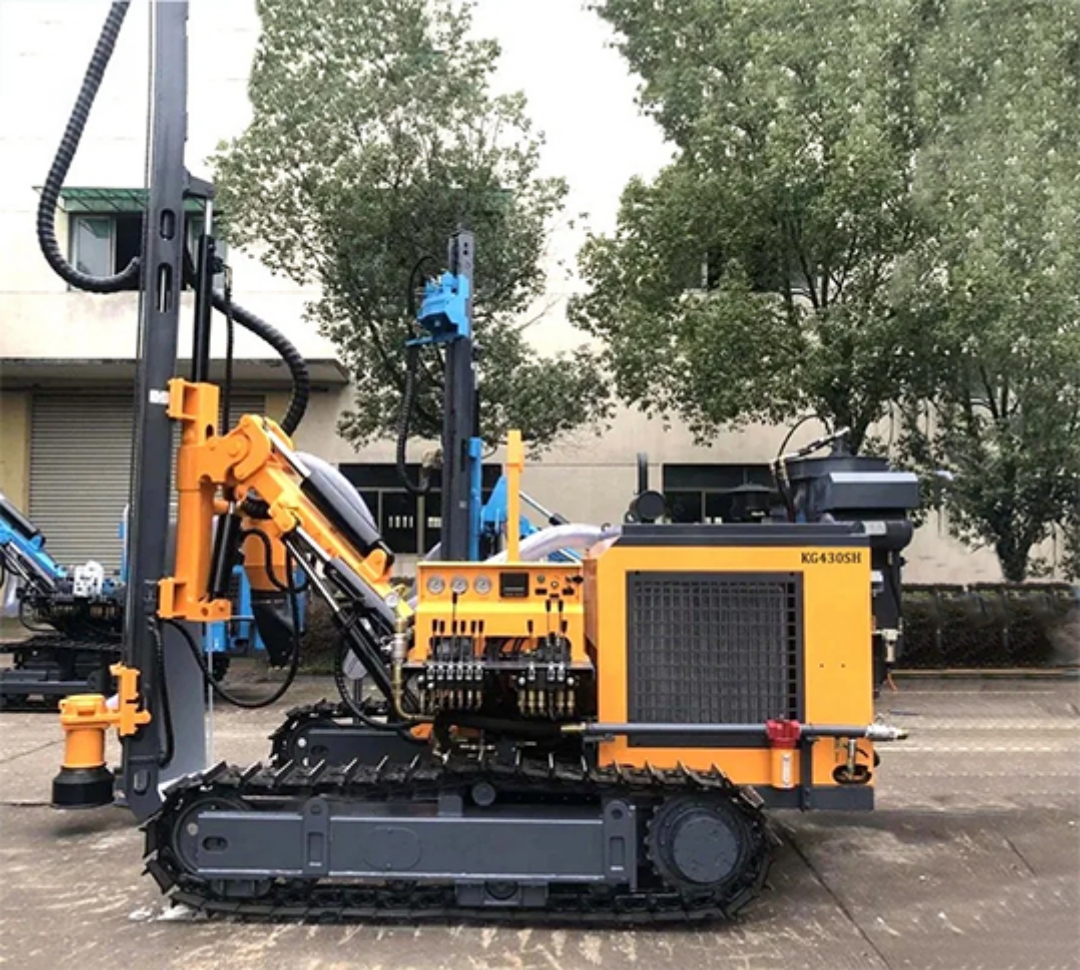
A DTH drilling rig uses a hammer positioned near the bottom of the borehole. Compressed air powers the hammer, which delivers repeated impacts to the drill bit. The bit breaks the rock while the drill string rotates and advances into the formation.
Air also helps carry rock cuttings out of the borehole. The rig’s feed system controls the advance of the drill string, while its rotary drive provides the torque needed to turn the drilling tools.
The drilling result depends on more than the machine itself. Rock hardness, hole diameter, bit selection, air pressure, air volume, and operating parameters all affect penetration rate and drilling efficiency.
A tracked drilling rig can be useful on uneven ground and at sites where the machine must be repositioned between drilling points. Compared with equipment designed mainly for paved or level surfaces, a suitable tracked chassis can provide better mobility across rough terrain.
Other factors matter just as much. The rig needs enough drilling capacity for the planned holes, and its feed system must provide the required travel and positioning range. Buyers should also consider machine dimensions, transport arrangements, maintenance access, and dust-control requirements.
For open-pit mining and quarrying, a dust collector can be an important part of the configuration. The Kaishan KG430S/KG430SH is equipped with a dust collector to support cleaner drilling operations.
Both surface DTH rigs and integrated DTH rigs use a down-the-hole hammer, but their layouts and supporting equipment can differ.
|
Comparison |
Surface DTH Drilling Rig |
Integrated DTH Drilling Rig |
|
Main design |
Surface drilling machine with a dedicated feed and chassis system |
Drilling system and supporting equipment integrated into one machine |
|
Mobility |
Depends on the chassis and running system |
Depends on the integrated chassis design |
|
Air supply |
Often paired with a compatible external compressor |
Some models have a built-in screw compressor |
|
Main consideration |
Terrain, drilling capacity, and compressor matching |
Mobility, drilling capacity, and equipment integration |
|
Example |
Kaishan KG430S/KG430SH |
Kaishan KT15C |
Neither type is automatically better for every project. A surface rig paired with an external compressor may be appropriate when the drilling operation requires a separate air supply. An integrated DTH rig can reduce the need to transport a separate compressor when its built-in system meets the drilling requirements.
The Kaishan KG430S/KG430SH is designed for surface drilling and is suitable for applications such as open-pit mining, quarrying, and rock drilling for construction projects.
The series uses independent diesel-engine and electric-motor systems, allowing separate operation of the two power systems. Its folding frame track and four-wheel-drive arrangement support site mobility, while the dual rotary motors increase rotary torque and speed. The machine also features a hydraulic feed and lifting system.
A dust collector is included in the rig’s configuration. For projects where air supply is provided by a separate compressor, Kaishan recommends the LGCY-18/17 or LGCY-19.5/19 mobile diesel screw air compressor series. The final compressor selection should account for hole diameter and air-hose length.
|
Parameter |
KG430S |
KG430SH |
|
Complete machine weight |
6,000 kg |
6,200 kg |
|
Dimensions (L × W × H) |
6,700 × 2,200 × 2,700 mm |
6,700 × 2,400 × 2,700 mm |
|
Drilling hardness |
f = 6–20 |
f = 6–20 |
|
Drilling diameter |
90–152 mm |
90–152 mm |
|
Economical drilling depth |
25 m |
25 m |
|
Rotary speed |
0–90 rpm |
0–90 rpm |
|
Rotary torque |
5,000 N·m |
5,000 N·m |
|
Lifting force |
40 kN |
40 kN |
|
Feed stroke |
3,980 mm |
3,980 mm |
|
Travelling speed |
0–2.5 km/h |
0–2.5 km/h |
|
Climbing capacity |
≤30° |
≤30° |
|
Ground clearance |
515 mm |
515 mm |
|
Supporting power |
Yuchai 58 kW / electric motor 55 kW |
Yuchai 58 kW / electric motor 55 kW |
|
DTH hammer |
K40 |
K40 |
|
Drill rod |
Φ76 × 3 m |
Φ76 × 3 m |
|
Air consumption |
13–20 m³/min |
13–20 m³/min |
The KG430S and KG430SH share the main drilling specifications, while their overall dimensions and weights differ. The choice between them should take account of the site layout, transport restrictions, and required operating configuration.
Start with the hole diameter and depth required by the drilling plan. A rig’s maximum drilling depth is not the only factor to consider; the machine must also suit the expected rock conditions and the required daily drilling output.
Next, check the air supply. The compressor needs to provide both the required pressure and sufficient air volume under actual operating conditions. Air-hose length and pressure losses should also be considered when selecting the compressor.
Finally, assess terrain, mobility, and dust control. A machine that can move around the site easily may reduce repositioning difficulties, while a suitable dust collector can help manage airborne dust during drilling. Confirm the complete configuration, including the hammer, drill rods, compressor, and optional equipment, before purchasing.
Kaishan offers surface DTH drilling rigs and integrated DTH drilling rigs for different rock-drilling requirements. The KG430S/KG430SH is an option for projects that need a surface drilling rig with a 90–152 mm hole diameter range and an economical drilling depth of 25 m.
To identify the right configuration, provide your target hole diameter, drilling depth, rock hardness, expected drilling volume, and site conditions. Kaishan can help you evaluate a suitable rig and compatible air compressor for your project.
It is commonly used for surface rock drilling in open-pit mines, quarries, road construction, and other projects that require blast-hole drilling in hard rock.
The listed drilling diameter is 90–152 mm for both models.
The product specifications list an economical drilling depth of 25 m. Actual drilling performance depends on rock conditions and the selected drilling configuration.
Kaishan recommends the LGCY-18/17 and LGCY-19.5/19 mobile diesel screw air compressors. The final choice should be based on the hole diameter, air-hose length, and actual pressure and air-volume requirements.
Their main drilling specifications are the same, but their listed dimensions and weights differ. The KG430S weighs 6,000 kg and measures 6,700 × 2,200 × 2,700 mm, while the KG430SH weighs 6,200 kg and measures 6,700 × 2,400 × 2,700 mm.
