 English
 Español
 Русский

Hole deviation in DTH drilling occurs when a borehole gradually moves away from its planned direction. It can affect drilling accuracy, especially in open-pit mining and blasting operations where hole position, inclination, and depth need to follow a defined pattern. Although some deviation is unavoidable in natural rock formations, it can often be reduced through proper rig alignment, suitable drilling tools, and controlled operating parameters. Understanding what causes a borehole to change direction is the first step toward improving drilling accuracy.
Hole deviation is usually related to a combination of geological conditions, drilling equipment, and operating practices.
Geological conditions are often difficult to control. Rock formations are rarely uniform. When a drill bit passes through alternating hard and soft layers, fractured zones, joints, or inclined bedding planes, the resistance acting on the bit may become uneven. The bit can then move toward the weaker part of the formation rather than following the planned direction.
Large boulders and uneven rock surfaces can also affect the initial drilling direction. If the bit starts at an angle or slips during the first stage of drilling, the deviation may continue to increase as the hole becomes deeper.
Equipment alignment and drill string condition are another important factor. If the drill rig is not positioned correctly, the feed beam is misaligned, or the drill rods are bent or worn, the drilling assembly may not remain on the intended path.
Operating parameters also matter. Excessive feed force, unsuitable rotation speed, unstable percussion, and inconsistent flushing can all contribute to poor hole quality. These factors should be considered together rather than adjusted independently.
The first part of a borehole deserves particular attention. A small directional error at the collar can become more noticeable as drilling progresses.
Before drilling, position the rig on stable ground and make sure the tracks or chassis are properly supported. Check that the feed beam is aligned with the planned hole direction and inclination. On uneven benches, the rig may need repositioning or leveling before the bit touches the rock.
Collaring should be carried out carefully. Start the hole with controlled feed and rotation rather than applying full force immediately. This allows the bit to establish a stable starting path before normal drilling conditions are applied.
For inclined blast holes, check both the planned angle and the direction of the feed beam. Correct alignment at the beginning cannot eliminate geological deviation, but it prevents avoidable errors caused by poor setup.
Drill bit condition and drill string stability have a direct influence on borehole accuracy.
A worn or damaged bit may no longer contact the rock evenly. Uneven button wear, damaged carbide inserts, or an unsuitable bit design can change how the bit interacts with the formation. Regular inspection and timely replacement help maintain consistent drilling performance.
Drill rods should also be checked for bending, thread damage, and abnormal wear. A damaged connection or an unstable drill string can introduce unwanted movement during rotation and percussion.
The relationship between the bit diameter and the diameter of the drilling tools behind it is also worth considering. Excessive clearance may allow more lateral movement, while the appropriate tool configuration helps maintain better guidance inside the hole. Where the drilling system supports them, suitable stabilizing components can further improve directional control.
DTH drilling relies on the impact energy of the hammer to break rock. However, stronger impact or higher feed force does not automatically produce a straighter hole.
The feed force needs to keep the bit properly engaged with the rock without overloading the drilling assembly. Excessive thrust can increase side loading and cause the bit or drill string to react poorly when encountering changes in rock hardness.
Rotation speed should be matched to the bit, hammer, hole diameter, and formation. Stable rotation helps the bit work consistently, while sudden changes in operating conditions may affect drilling direction and hole quality.
Compressed air also plays an important role. It powers the DTH hammer and carries rock cuttings out of the hole. Insufficient air supply or poor cuttings removal can reduce drilling efficiency and contribute to unstable hole conditions.
There is no single combination of feed force, rotation speed, and air pressure that suits every formation. Operators should follow the hammer and rig manufacturer’s recommendations and adjust the parameters according to actual drilling conditions.
Visual inspection of the drill rig and drilling process is useful, but it cannot always reveal how far a borehole has moved from its planned trajectory.
For operations with strict accuracy requirements, borehole deviation should be measured rather than estimated. Inclination and azimuth measurements can show whether the hole is gradually changing direction or developing a more pronounced deviation at a particular depth.
For production blast holes, the required inspection method depends on hole depth, drilling pattern, and site accuracy requirements. More demanding drilling programs may use dedicated borehole survey instruments to check the hole trajectory.
If measurements show a consistent deviation trend, the drilling setup, tooling, and operating parameters should be reviewed before continuing with the same approach. Simply increasing feed force is not a reliable correction method.
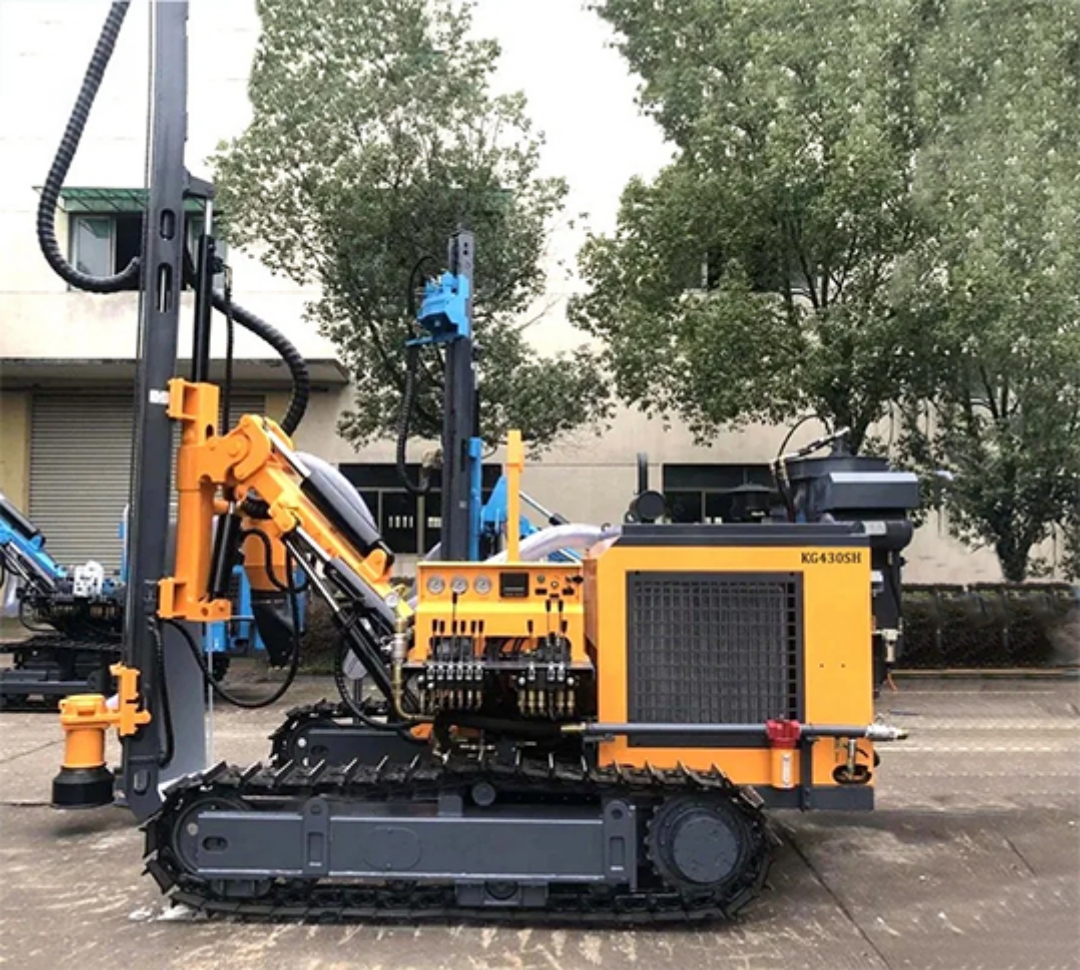
Kaishan offers DTH drilling rigs for open-pit mining and other rock drilling applications. The KG430S and KG430SH models are designed for drilling hole diameters from 90 to 152 mm, with an economical drilling depth of 25 m.
Both models feature a rotary torque of 5,000 N·m and a lifting force of 40 kN. Their feed system uses an oil cylinder and leaf chain, while the drilling beam can be adjusted to support different drilling positions.
These specifications provide the mechanical capacity required for a range of open-use DTH drilling operations. Actual hole accuracy still depends on geological conditions, rig positioning, drill bit and rod condition, and correct operating practices.
Selecting suitable equipment is important, but maintaining a stable drilling process is equally necessary for controlling hole deviation.
Not in every geological condition. Rock joints, fractured formations, changes in hardness, and other natural features can affect the drilling direction. The practical objective is to keep deviation within the limits required by the drilling application.
Not necessarily. Excessive feed force can increase side loading and make the drilling assembly less stable. Feed force should be matched to the hammer, bit, and rock formation.
For applications requiring accurate hole trajectories, dedicated borehole survey instruments can measure inclination and azimuth at different depths. Visual checks of rig alignment are useful during setup but cannot replace trajectory measurements.
Rig leveling, feed beam alignment, drill string condition, bit wear, and the stability of the feed and rotation systems can all influence hole straightness. Geological conditions remain an important factor as well.
