 English
 Español
 Русский

A reverse circulation (RC) drilling rig is mainly used for mineral exploration, ore-grade testing, and geological prospecting. It collects rock cuttings from underground formations and brings them to the surface for analysis, helping exploration teams understand the location, depth, and distribution of mineral deposits.
Unlike drilling methods primarily used to create boreholes for water supply or construction, RC drilling focuses on obtaining representative rock samples efficiently. This makes it particularly useful in open-pit mining and mineral exploration projects.
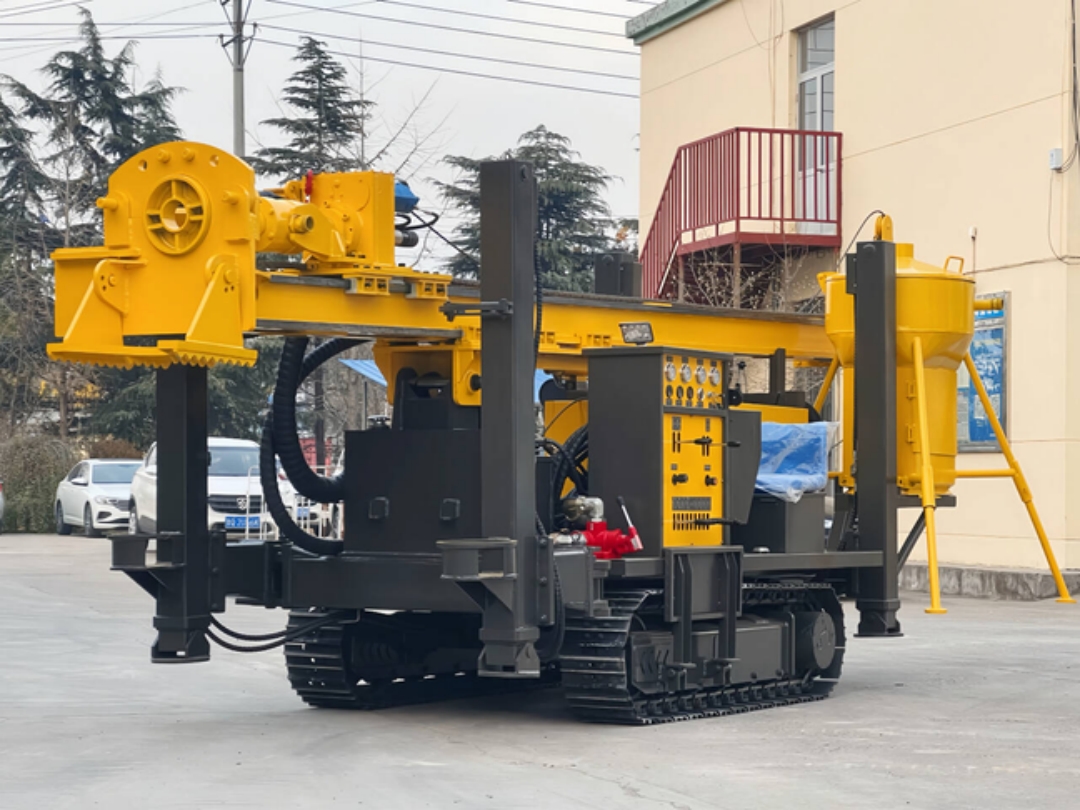
Mineral exploration is one of the main applications of RC drilling. Before a mining project moves into development, exploration teams need information about underground geology and possible mineral deposits.
RC drilling produces rock cuttings from different depths, which can be collected and analyzed to identify mineral-bearing formations. These samples help geologists investigate whether a target area contains economically interesting mineralization and determine where further exploration may be needed.
RC drilling is commonly used in the exploration of gold, copper, iron ore, and other mineral deposits.
RC drilling is also used to evaluate ore grades in known or suspected mineralized areas.
During drilling, samples are collected at regular intervals and sent for laboratory analysis. The results help geologists estimate the distribution and concentration of valuable minerals across the drilled area.
This information is useful when assessing a potential mining zone, comparing different sections of a deposit, and planning further exploration. Reliable sample collection is important because poor or contaminated samples can affect geological interpretation.
In open-pit mining projects, RC drilling is often used to investigate mineral deposits before and during mine development.
Drilling at different positions and depths helps build a clearer picture of the geological structure beneath the surface. Exploration teams can use the results to identify mineralized zones, understand changes in ore distribution, and support decisions about where additional drilling is required.
For these projects, an RC drilling rig needs to provide suitable drilling depth, stable operation, and efficient sample recovery under field conditions.
RC drilling is suitable for geological prospecting when teams need to investigate underground formations over a relatively large area.
By collecting samples from multiple boreholes, geologists can compare rock types and mineral content at different locations. The results help establish the geological characteristics of an area and identify targets for more detailed investigation.
RC drilling is particularly useful when the project requires a large number of exploration holes and relatively fast sample collection.
The main advantage of RC drilling is its sample collection method. It uses double-wall drill pipes and compressed air to transport rock cuttings from the bottom of the borehole to the surface through the inner tube.
This provides a more controlled sample return path than methods in which cuttings travel through the annular space around the drill string. It helps reduce sample contamination from material along the borehole and allows samples to be collected during drilling.
RC drilling is therefore a practical option for exploration projects that require frequent sampling and geological analysis.
However, it is important to distinguish between rock cuttings and core samples. RC drilling generally produces fragmented rock material, while core drilling recovers cylindrical sections of rock. If a project requires intact core samples for detailed structural analysis, a core drilling rig may be more appropriate.
Kaishan offers the RC300 and RC500 Reverse Circulation Drilling Rigs for mineral sampling, ore-grade testing, and geological prospecting. The two models provide different drilling capacities for exploration projects.
|
Parameter |
RC300 |
RC500 |
|
Maximum drilling depth |
300 m |
500 m |
|
Maximum drilling diameter |
Φ350 mm |
Φ400 mm |
|
Rated power |
92 kW |
132 kW |
|
Lifting force |
20 T |
28 T |
|
Drill rod diameter |
89 / 102 mm |
89 / 102 mm |
|
Maximum feeding stroke |
3,600 mm |
3,600 mm |
|
Weight |
8 T |
10.5 T |
The RC300 Reverse Circulation Drilling Rig is designed for open-pit mineral sampling, ore-grade inspection, and geological prospecting. With a maximum drilling depth of 300 m and a maximum drilling diameter of Φ350 mm, it is suitable for exploration projects with moderate depth requirements.
For projects requiring greater drilling capacity, the RC500 Reverse Circulation Drilling Rig offers a maximum drilling depth of 500 m and a maximum drilling diameter of Φ400 mm. Its 132 kW rated power and 28 T lifting force support deeper mineral exploration operations.
Choosing between the two models depends on the required drilling depth, hole diameter, geological conditions, and project workload. The drilling rig should be selected according to the actual exploration requirements rather than maximum specifications alone.
Kaishan provides reverse circulation drilling equipment for different mineral exploration needs. With the RC300 and RC500 models, customers can select a suitable rig based on drilling capacity and site conditions.
It is mainly used for mineral exploration, ore-grade testing, open-pit mining exploration, and geological prospecting. Its primary purpose is to collect underground rock cuttings for geological and mineral analysis.
Yes. RC drilling is widely used in gold exploration because it can collect rock samples from different depths for mineral analysis and help identify gold-bearing zones.
RC drilling generally collects fragmented rock cuttings rather than intact cylindrical cores. These cuttings are transported to the surface through the inner tube of the double-wall drill pipe.
RC drilling collects fragmented rock cuttings, while core drilling recovers cylindrical rock cores. RC drilling is commonly used for relatively fast mineral exploration and grade testing, whereas core drilling is preferred when intact rock samples are needed for detailed geological analysis.
The Kaishan RC300 has a maximum drilling depth of 300 m, while the RC500 can reach up to 500 m. Actual drilling performance depends on geological conditions and the selected drilling configuration.
